 Maksym Kovaliov
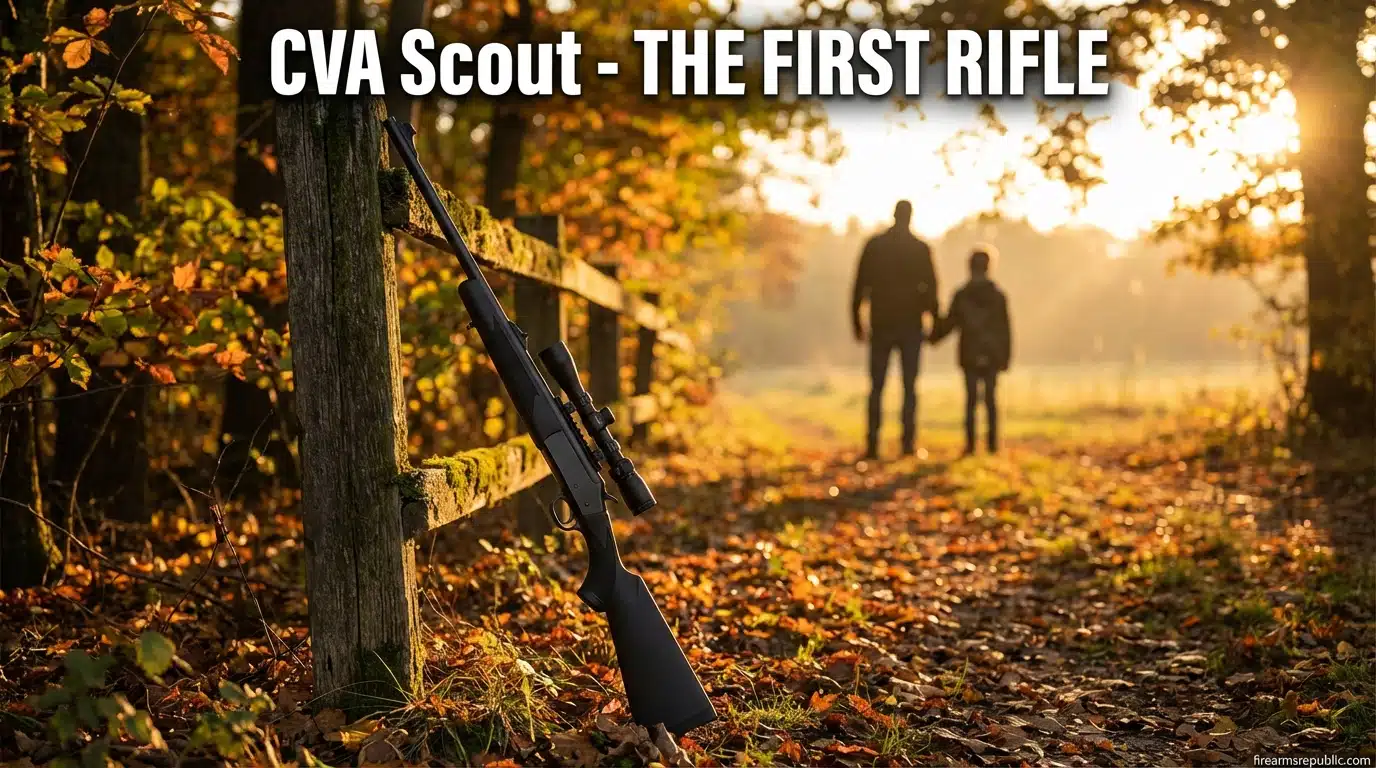
The first hunting rifle a new shooter uses shapes their relationship with firearms for years. A rifle that’s too heavy, kicks too hard, or is too mechanically complex to understand confidently leaves new hunters feeling intimidated rather than empowered. The opposite – a rifle matched to the shooter’s size, experience level, and hunting application – builds the competence and confidence that produces lifelong hunters.
The CVA Scout deserves more attention in this conversation than it typically gets. Most first-rifle recommendations default immediately to bolt-actions – Ruger Americans, Savage Axis IIs, Mossberg Patriots – and those are reasonable choices. But the Scout has specific advantages for youth and new hunters that bolt-action recommendations overlook.
This guide makes the case for the Scout as a first hunting rifle, covers the best calibers for new hunters by age and application, explains how the 2025 Scout’s adjustable stock fits shooters of different sizes, and gives practical guidance on transitioning a new hunter from the range to the field.
Why a Single-Shot Makes Sense as a First Rifle
The single-shot rifle has been the traditional first hunting rifle in American hunting culture for most of the country’s history. Before repeating rifles became affordable and widely available, single-shots were what young hunters learned on. The H&R Handi-Rifle, the .22 single-shot bolt-action, the break-action .410 – these are the rifles that generations of American hunters used to take their first deer, their first squirrel, their first turkey.
The case for a single-shot as a first rifle is not nostalgia. It’s practical.
Mechanical simplicity: A break-action single-shot has fewer parts than any repeating rifle. The loading sequence is direct and visible: open the action, confirm the chamber is empty, insert a round, close the action. There’s no bolt to cycle, no magazine to manage, no gas system to explain. For a new shooter who is simultaneously learning firearm safety, hunting regulations, shot placement, and field skills, eliminating mechanical complexity helps.
Built-in shot discipline: A new hunter with one round in the rifle takes more deliberate shots than one with five. This is not a disadvantage – it’s a teaching tool. The single-shot format enforces the habits that experienced hunters eventually develop anyway: wait for the right angle, confirm the target, make a confident shot. Teaching these habits from the first hunt produces better hunters faster than starting with a magazine-fed platform.
Lighter weight: The Scout in .243 or .350 Legend weighs approximately 5.8–6.2 lbs unscoped. For a child or smaller adult, the weight difference between a 6-lb Scout and an 8-lb bolt-action with a heavy barrel and a full-size stock matters significantly for the ability to hold steady and carry the rifle through a hunting day.
Lower cost: A Scout in .243 Winchester costs $375–$450. For a parent or grandparent buying a first hunting rifle for a young hunter who may or may not continue hunting into adulthood, this price point reduces the financial risk of the investment.
The 2025 Scout’s Adjustable Stock: Why It Matters for Youth
The 2025 generation CVA Scout introduced an adjustable length of pull and adjustable comb height via removable stock spacers. This is a significant practical improvement over the V2’s fixed stock, and it matters more for youth hunters than for adults.
Length of pull (LOP) is the distance from the trigger to the back of the stock. Standard adult hunting rifles have LOP around 13.5″–14″. A ten-year-old who needs 11.5″–12″ LOP on a standard stock is stretching to reach the trigger, compromising position and control. The 2025 Scout’s adjustable system accommodates a range of LOP, allowing the rifle to fit a young hunter properly.
Comb height affects where the shooter’s cheek contacts the stock, which determines eye alignment with the scope. A scope mounted for an adult’s face sits too high for a child’s shorter facial geometry. Adjustable comb allows the scope height to match the shooter’s eye without shimming or aftermarket stock replacement.
For families where a rifle will be shared between a parent and a child, or between siblings of different sizes, the adjustable stock is particularly valuable. One rifle can be properly fitted to multiple shooters by adjusting the spacers.
If you’re buying for a youth hunter and the 2025 Scout is available at a reasonable price compared to the V2, the adjustable stock alone justifies any modest price premium.
Best First-Rifle Calibers in the CVA Scout
.243 Winchester – The Classic Youth Deer Cartridge
The .243 Winchester has been America’s standard youth and first-hunter deer cartridge for decades, and the Scout’s 20″ configuration makes it one of the best platforms for this caliber.
From a 20″ Scout barrel with 95–100gr hunting bullets:
- Recoil: approximately 8–9 ft-lbs – less than .243’s reputation suggests
- Velocity: ~2,850–2,900 fps
- Energy at 200 yards: ~1,350 ft-lbs – adequate for deer
- Trajectory: flat enough for 200-yard shots without complex holdover
The .243’s recoil is mild enough that most 10–12 year olds can shoot it comfortably from proper position with a good recoil pad. For comparison, a 20-gauge shotgun slug produces approximately 20 ft-lbs of recoil – the .243 at 8–9 ft-lbs is less than half that.
For whitetail deer, mule deer, and pronghorn inside 200 yards, the .243 with a proper hunting bullet (Federal 95gr Trophy Bonded Tip, Hornady 95gr SST) is entirely adequate. The honest limitation: very large northern whitetail bucks at steep angles test the .243’s margins. For average deer in average hunting scenarios, a new hunter using a properly fitted .243 Scout can confidently take clean shots.
The .243 also works for varmint hunting with lighter 55–75gr bullets at higher velocity. A Scout .243 is a reasonable multi-purpose first rifle that handles both deer season and spring varmint trips.
Recommended starting load for new shooters: Winchester 80gr Deer Season XP – the lighter bullet reduces recoil slightly below standard 95–100gr loads while maintaining adequate deer performance. Use this to build confidence at the range before switching to the heavier hunting loads for the field.
.350 Legend – The Modern Low-Recoil Deer Cartridge
For youth hunters in straight-wall states (Ohio, Michigan, Indiana, Iowa), the .350 Legend has become the default first deer cartridge recommendation for good reason.
From a 20″ Scout barrel:
- Recoil: approximately 8 ft-lbs – essentially identical to .243 Winchester
- Velocity: ~2,100–2,200 fps with 150–170gr bullets
- Energy at 150 yards: ~1,200–1,350 ft-lbs – adequate for deer
The .350 Legend was specifically designed to be legal for straight-wall deer seasons while maintaining recoil low enough for youth and new hunters. Winchester’s decision to optimize for this application produced a cartridge that’s become the dominant first deer rifle choice in restricted states.
For a young hunter in Ohio taking a first deer from a ground blind or stand, the Scout .350 Legend is arguably the best possible first deer rifle combination. It’s straight-wall compliant, low recoil, affordable to shoot, and fits properly with the Scout’s adjustable stock.
Ammunition note: The .350 Legend’s selection of light-recoil practice loads makes it particularly good for range work before hunting season. Winchester’s 145gr FMJ training loads at $18–$20/box let a new hunter run 50–100 rounds without developing a flinch.
.308 Winchester – The Versatile Step-Up
For older youth hunters (14+) or adult first-time hunters with normal recoil tolerance, the .308 Winchester provides capabilities the lighter calibers don’t.
The .308 Scout’s 18–20 ft-lbs of felt recoil is manageable for most adults and older teenagers with proper shooting position and the CrushZone recoil pad. The trade-off for the heavier recoil is significantly more versatility: the .308 handles deer, elk, black bear, hog, and most other North American game without changing rifles.
For a first rifle intended to serve a teenager through adulthood across multiple hunting applications, the Scout .308 is the more practical long-term choice than the .243 or .350 Legend. A 14-year-old who starts deer hunting with a Scout .308 can use that same rifle for elk at 21 and hog at 35 without ever feeling undergunned.
See our .308 Winchester Caliber Guide for full cartridge details.
Age and Physical Size Considerations
Ages 9–11 (smaller build, first year hunting):
- Best caliber: .243 Winchester or .350 Legend
- Key concern: LOP adjustment to fit properly – use 2025 Scout with spacers set to minimum
- Practical range: 50–100 yards to start; confidence at short range before extending
- Scope: 2–7×32 or fixed 4× – simple, no complex dials to manage
- Session length: short range sessions (15–20 rounds maximum) to avoid building recoil sensitivity
Ages 12–14 (growing, second or third year hunting):
- Best caliber: .243 or .350 Legend (smaller build); .308 (larger, athletic build)
- LOP adjustment can be opened from junior settings as the hunter grows
- Practical range: 100–150 yards as confidence builds
- Introduce the concept of windage and drop at 150+ yards as a learning exercise
Ages 14+ and adult new hunters:
- .308 or 6.5 Creedmoor for most applications
- Full adult LOP setting
- Practical range: 150–200 yards as primary shooting distance with range work at 200+
Adult new hunters with recoil sensitivity (smaller frame, medical considerations, or simply recoil-averse):
- .243 or .350 Legend regardless of age
- There’s no minimum caliber requirement for effective deer hunting inside 150 yards with proper bullet selection
Setting Up the Scout for a Young Hunter
Step 1 – Fit the stock. Before anything else, adjust the LOP so the new hunter can comfortably reach the trigger from a seated or kneeling shooting position without straining. The trigger finger should contact the trigger at the first pad (not the joint) with the arm naturally bent. The CrushZone pad should contact the shoulder firmly without the hunter needing to reach forward.
Step 2 – Mount a simple scope at the right height. A low-power variable (2–7×32 or 1–4×24) or a fixed 4× is appropriate for youth hunters. High magnification makes close shots harder and creates parallax errors at short range – a youth hunter in a ground blind who encounters a deer at 40 yards needs to see it clearly, not struggle with a 12× scope dialed to 200 yards. Medium rings typically work well with standard objective lenses. Verify eye relief with the hunter’s actual eye position before cementing the setup.
Step 3 – Establish safe handling habits with an unloaded rifle before going to the range. The Scout’s visible chamber when open is a significant teaching tool. A young hunter who can open the action, visually confirm the chamber is empty, and verbally confirm “clear” before handling develops safety habits that persist for life. Practice the opening/closing sequence, trigger discipline, and muzzle direction before any live fire.
Step 4 – Range sessions with low-recoil loads first. Start with the lighter training loads – Winchester .350 Legend FMJ, Winchester .243 80gr Deer Season XP – at 50 yards from a bench rest. Confirm zero, build confidence, then introduce field positions (sitting, kneeling, using shooting sticks) before hunting season.
Step 5 – Practice the single-shot reload sequence. A single-shot does require a conscious reload process. Teach the young hunter to: fire, keep the muzzle downrange, open the action deliberately, remove the spent case, insert a fresh round, and close the action. This should become automatic. Timed practice builds the muscle memory for field situations where fine motor skills are compromised by cold or adrenaline.
The Scout vs Bolt-Action for First Rifles: Honest Comparison
The Ruger American Gen II in .243 and the CVA Scout in .243 cost roughly the same and are frequently compared as first rifle options. Here’s the honest breakdown:
Ruger American Gen II advantages:
- 4-round AICS-compatible magazine for follow-up shots
- Better aftermarket upgrade path (stocks, triggers)
- More familiar manual of arms for future bolt-action transition
- Adjustable trigger (Ruger Marksman)
See our Ruger American Complete Guide for full details.
CVA Scout advantages:
- Simpler action – easier to teach safe handling fundamentals
- Single-shot discipline builds better shooting habits from the start
- Lighter weight in most configurations
- Visible chamber when open – excellent teaching tool for safety habits
- Bergara barrel accuracy equal to or better than comparable bolt-actions
For a new hunter who will hunt deer from stands or blinds where follow-up shots are rarely needed, the Scout is a completely legitimate first rifle. For a hunter who will pursue game in situations where quick follow-up shots matter – flushing birds with a rifle (rare but exists), running hogs, dense cover deer – a bolt-action is more practical from the start.
Most youth deer hunters take their first deer from a stand or blind. For this context, the Scout is an excellent choice.
First-Season Hunting Preparation Checklist
Before a new hunter’s first season with a Scout, verify:
Equipment:
- Scope mounted, zeroed at 100 yards (or 50 yards for younger hunters), confirmed with multiple sessions
- Sling installed for field carry
- Safety/hammer operation practiced until automatic
- Reload sequence practiced until confident
Skills:
- Safe handling habits confirmed: muzzle direction, trigger discipline, action check
- Field positions practiced: sitting with shooting sticks, kneeling
- Shot placement understood: lung/heart zone, appropriate angles
- Range work at actual hunting distances complete
Regulations:
- Hunter education completed (required in all states for first-time hunters)
- License and tags acquired
- Know the specific unit’s legal shooting hours, legal caliber requirements (straight-wall states), and any other applicable rules
FAQ
Q: What is the minimum age to use a CVA Scout for deer hunting?
A: Age minimums for hunting are set by state wildlife agencies, not by the firearm. Most states require a minimum age of 10–12 for unsupervised hunting, with younger hunters allowed under direct adult supervision. The Scout’s weight and recoil are appropriate for physically mature 9–10 year olds in lighter calibers (.243, .350 Legend). Hunter education certification is required in all US states for first-time hunters regardless of age.
Q: Is .243 Winchester enough for elk?
A: Marginal. The .243 is an adequate deer cartridge but is at the lower end of suitable elk calibers. For a young hunter who will grow into elk hunting, a Scout .308 or 6.5 Creedmoor is a better long-term first rifle choice. If you’re buying specifically for deer now with elk in mind later, start with .308.
Q: How do I reduce recoil further for a small child?
A: Beyond caliber choice (.243 and .350 Legend are already mild), add a slip-on recoil pad like the Pachmayr Decelerator ($20) for range sessions. Proper shooting position – stock firmly in the shoulder pocket, forward hand supporting the forestock – absorbs recoil more effectively than a loose or reaching position. Recoil is felt most strongly when the fit is wrong; a properly fitted Scout in .243 is genuinely comfortable for most 10-year-olds.
Q: Should a first-time adult hunter buy a Scout or a bolt-action?
A: Either is appropriate for deer hunting. The Scout’s advantages – simplicity, lower weight, Bergara accuracy – are real. The bolt-action’s advantages – magazine capacity, upgrade path, familiar manual of arms – are also real. For an adult who hunts whitetail from a stand and wants a simple, reliable, accurate rifle at minimum cost, the Scout is an excellent choice. For an adult who wants flexibility for multiple applications over time, a bolt-action like the Ruger American gives more room to grow.
Q: Is the CVA Scout safe for a 10-year-old to operate independently?
A: A Scout fitted to the child’s dimensions in .243 or .350 Legend, after proper hunter education and adult-supervised range training, is mechanically safe for a supervised young hunter. The break-action design with visible chamber is actually one of the more intuitive and verifiable safe-action designs for new shooters. Supervised field use under an adult hunter’s direct oversight is the appropriate first-season approach regardless of the rifle chosen.
Related Guides
- CVA Scout Complete Guide
- CVA Scout for Straight-Wall Deer Hunting States
- CVA Scout for Deer Hunting
- Best Rifles for New Shooters
- Whitetail Deer Hunting Rifles
- .243 Winchester Caliber Guide
- .308 Winchester Caliber Guide
- Ruger American Complete Guide