
 Firearms Republic
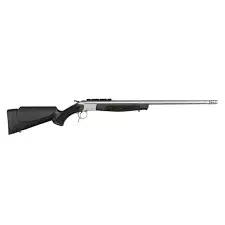
The .450 Bushmaster was designed with a specific mission: create the most powerful straight-wall cartridge possible for deer hunters in states that restrict bottlenecked rifle rounds. Tim LeGendre achieved that goal. Nearly two decades after its introduction, the .450 Bushmaster remains the hardest-hitting straight-wall deer cartridge in common production – and the CVA Scout is one of the best platforms to run it from.
The CVA Scout in .450 Bushmaster costs $400–$475 and delivers more muzzle energy than a .30-06 Springfield from a 22″ barrel. No other production rifle at anywhere near this price puts that kind of authority into a hunter’s hands in a straight-wall-legal package. For Ohio, Michigan, and Indiana hunters who want maximum performance from their legal cartridge options, this combination deserves serious consideration.
This review covers the .450 Bushmaster’s real-world performance from the Scout’s 22″ barrel, how it compares to the .350 Legend and .360 Buckhammer at hunting distances, what the recoil is actually like and how the muzzle brake changes things, the best ammunition choices, and exactly who this rifle and cartridge make sense for.
Why .450 Bushmaster Exists
Understanding the cartridge’s design intent helps clarify when it’s the right choice and when it isn’t.
In the late 1990s and early 2000s, states with straight-wall cartridge laws offered hunters limited options. The .357 Magnum, .44 Magnum, and .45-70 were legal in most of these states, but all three produced limited performance from standard rifle barrels – either through marginal energy on large deer or steeply arching trajectories that made shots past 100 yards difficult. The .45-70 was the most powerful option but lived primarily in lever-actions with tubular magazines that restricted hot modern loads.
Tim LeGendre and later Hornady developed the .450 Bushmaster to fill this gap: a straight-wall cartridge generating genuine rifle-class energy from a modern single-shot or AR-15 platform, with adequate trajectory for 200-yard shots on deer-sized game. The rebated rim design allows the cartridge to fit in an AR-15 bolt face with a modified bolt head and barrel.
The result is a cartridge that hits harder at 200 yards than .44 Magnum hits at the muzzle, while remaining straight-wall legal in every state that allows the category.
CVA Scout .450 Bushmaster Specifications
Scout V2 (.450 Bushmaster):
- Barrel Length: 22″
- Barrel Twist: 1:16
- Barrel Material: 416 stainless steel, fluted
- Action: Break-action single-shot
- Weight: approximately 5.9 lbs (rifle only)
- Muzzle brake: KDF brake included on most configurations
- Stock: Synthetic, ambidextrous
- Threaded: varies by configuration (5/8×24 on threaded models)
2025 Scout (.450 Bushmaster):
- Same barrel specifications
- Adjustable LOP and comb height via stock spacers
- Picatinny rail standard
- Steel sling swivel studs
Street price: $400–$475 depending on configuration and retailer.
Ballistic Performance from the 22″ Scout Barrel
The .450 Bushmaster from a 22″ barrel is a meaningfully different proposition than the same cartridge from a 16″ AR-15 barrel. Longer barrel means more velocity, more energy, and better terminal performance. The CVA Scout’s 22″ tube extracts nearly full potential from the cartridge.
Factory load performance from 22″ barrel (zeroed at 100 yards):
| Load | MV (fps) | ME (ft-lbs) | 100 yd energy | 200 yd energy | Drop at 200 yds |
|---|---|---|---|---|---|
| Hornady 250gr FTX | 2,200 | 2,686 | 2,082 | 1,588 | -7.8″ |
| Federal 300gr Trophy Bonded | 1,900 | 2,405 | 1,873 | 1,464 | -10.5″ |
| Remington 260gr Core-Lokt | 2,180 | 2,744 | 2,113 | 1,618 | -8.1″ |
| Winchester 260gr Power-Max | 2,100 | 2,544 | 1,961 | 1,506 | -9.0″ |
| Underwood 260gr Xtreme Penetrator | 2,200 | 2,795 | 2,157 | 1,651 | -7.6″ |
At 100 yards, any of these loads delivers 1,800–2,100 ft-lbs of energy – well above the 1,500 ft-lbs minimum most experienced hunters use as a threshold for deer-sized game. At 200 yards, all loads except the heavier Federal 300gr remain above 1,500 ft-lbs.
Compare this to the .350 Legend at the same distances: approximately 1,350–1,500 ft-lbs at 100 yards and 1,100–1,200 ft-lbs at 200 yards. The .450 Bushmaster delivers 40–50% more energy at 100 yards. On deer-sized game, that difference is visible in the field – deeper penetration, wider wound channels, and more decisive anchor performance on large animals.
Trajectory reality: The .450 Bushmaster is not a flat-shooting cartridge. A -7.8″ drop at 200 yards from a 100-yard zero requires a deliberate holdover to shoot accurately at distance. Hunters who regularly take 200-yard shots should consider a 150-yard zero, which gives approximately -3″ at 200 yards and +2″ at 75–100 yards – more manageable for field shooting.
The Recoil Question: What It’s Actually Like
The .450 Bushmaster in a 6-lb single-shot rifle produces approximately 28–32 ft-lbs of felt recoil. That’s substantial – comparable to a .300 Winchester Magnum in a standard sporter stock, and significantly more than .308 Winchester (18–20 ft-lbs) or .350 Legend (8 ft-lbs).
Without a muzzle brake, the Scout .450 Bushmaster is a full-power shoulder experience. The CrushZone recoil pad helps, but a 30 ft-lb recoil event in a sub-6-lb rifle is not subtle. Hunters who are recoil-sensitive, who want to shoot multiple practice rounds, or who are introducing younger hunters to the cartridge should strongly consider the brake.
With the KDF muzzle brake:
Most Scout V2 .450 Bushmaster configurations ship with the KDF muzzle brake as standard equipment. The brake reduces felt recoil by approximately 35–40%, bringing perceived recoil down to approximately 18–20 ft-lbs – comparable to a .308 Winchester in a similar rifle. This is manageable for virtually all adult hunters.
The trade-offs with the brake: muzzle blast increases noticeably, both in volume and in lateral pressure. Hunting in an enclosed blind with the brake on is louder than without it. Hunting partners standing to the sides of a braked .450 Bushmaster feel the concussion. For solo stand hunting or open-air blind work, the brake is the right call. For hunting in close proximity to partners, consider a suppressor instead if the barrel is threaded.
2025 Scout ported barrel configurations:
Some 2025 Scout .450 Bushmaster configurations ship with a ported barrel rather than the removable KDF brake. The ports function similarly – redirecting gases to reduce felt recoil – but the barrel cannot accept a suppressor or standard threaded accessories. If suppressor hunting is a consideration, verify you’re getting a threaded-barrel configuration before ordering.
.450 Bushmaster vs .350 Legend vs .360 Buckhammer
This is the core decision for straight-wall state hunters, and it deserves an honest answer based on hunting scenarios rather than pure ballistic bragging rights.
For deer inside 150 yards from a stand or blind:
All three cartridges produce clean kills with good shot placement. The .350 Legend and .360 Buckhammer’s lower recoil and faster follow-up capability (in repeating rifles) are meaningful advantages in this scenario. The .450 Bushmaster’s additional energy doesn’t significantly improve outcomes on average deer at average distances when shots are well-placed.
For deer at 150–200 yards in open agricultural fields:
The .450 Bushmaster’s energy advantage becomes more relevant. At 175 yards, the .450 Bushmaster retains approximately 1,700 ft-lbs while the .350 Legend retains approximately 1,250 ft-lbs. Both are adequate for deer, but the margin with the .450 Bushmaster is more comfortable.
For large-bodied northern whitetail bucks:
Mature Midwest bucks regularly run 200+ lbs. The .450 Bushmaster’s wider diameter (.452″ vs .357″ for .350 Legend) and significantly greater energy produce more decisive performance on these animals, particularly on quartering shots that require deep penetration.
For hogs as secondary application:
This is where the .450 Bushmaster differentiates itself most clearly. Large feral hogs in Texas and the Southeast run 200–350 lbs with heavy shield bone. The .350 Legend is marginal on big boars; the .450 Bushmaster is definitive. A hunter who uses the same rifle for both deer season and hog hunting year-round should choose the .450 Bushmaster.
Bottom line: If you hunt average deer inside 150 yards and want low recoil, choose .350 Legend. If you hunt large deer at moderate range or use the rifle for hogs as well as deer, the .450 Bushmaster’s additional performance justifies the additional recoil.
See our detailed CVA Scout Straight-Wall States Guide for the full cartridge comparison.
Best Ammunition for the CVA Scout .450 Bushmaster
Hornady 250gr FTX LEVERevolution – ~$40–$48/box: The standard recommendation for most hunters. The polymer tip improves BC over traditional flat-nose designs, and the 250gr weight delivers good terminal performance without the recoil of heavier loads. This is the load most Scout .450 Bushmaster owners use as their primary hunting round. Consistent accuracy at 0.9–1.2 MOA from most Scout barrels.
Remington 260gr Core-Lokt – ~$35–$42/box: The most economical premium option. Core-Lokt is a bonded lead-core bullet with reliable expansion and adequate penetration for deer-sized game. Slightly heavier than the FTX at 260gr with similar velocity. Good choice for hunters who want a reliable hunting load without the FTX’s premium pricing.
Federal 300gr Trophy Bonded Bear Claw – ~$55–$65/box: For hunters who use the same rifle for hogs, black bear, or any application where deep penetration through heavy material matters above expansion. The Trophy Bonded Bear Claw uses a solid copper rear shank and bonded lead front section that drives straight through shield bone and heavy muscle. Higher recoil due to heavier bullet, but the terminal performance on tough game is exceptional.
Underwood 260gr Xtreme Penetrator – ~$55–$65/box: A monolithic copper solid designed for maximum penetration. No expansion – pure deep-penetrating wound channel. The best choice for hunters facing large or potentially dangerous game at close range. Significant recoil. Not a deer cartridge in the traditional sense – use it for hogs at close range or any situation where you need the bullet to go through rather than open up.
Winchester 260gr Power-Max Bonded – ~$38–$44/box: Good middle-ground hunting load with bonded construction for reliable weight retention. Slightly lower velocity than the Hornady FTX but adequate accuracy and consistent terminal performance on deer-sized game.
What to avoid: Light plinking loads designed for AR-15 suppressor applications, and any .450 Bushmaster ammunition labeled specifically for AR-15 use with reduced-pressure loads. These are safe in the Scout but significantly underperform hunting-grade loads in energy and terminal performance.
Accuracy: Real-World Groups from the Scout .450 Bushmaster
The .450 Bushmaster is not a precision cartridge by nature. The .452″ flat-nose or soft-polymer-tip bullets have lower BC than high-BC hunting bullets in smaller calibers. Expect hunting accuracy, not match accuracy.
Typical factory ammo groups at 100 yards from a rested Scout .450 Bushmaster:
- Hornady 250gr FTX: 0.9–1.3 MOA
- Remington 260gr Core-Lokt: 1.0–1.5 MOA
- Federal 300gr Trophy Bonded: 1.2–1.8 MOA
At 200 yards, these groups open proportionally. A 1.0 MOA rifle printing 1″ groups at 100 yards will print approximately 2″ at 200 yards under ideal conditions – with field variables like wind and shooter position, practical 200-yard groups run 3–4″ from most hunters in most conditions.
For deer hunting purposes, a 4″ group at 200 yards means the bullet lands within the vital zone (approximately 8–10″ diameter on a deer) if aim is on center. It’s adequate for experienced hunters who know their hold. For new hunters or those hunting under difficult conditions, keeping shots inside 150 yards with the .450 Bushmaster is the more prudent approach.
Hand-loaders report that the Scout .450 Bushmaster responds well to load development with cast lead bullets and moderate powder charges. Groups in the 0.7–0.9 MOA range are achievable with careful load development – significantly better than most factory options.
Optics for the Scout .450 Bushmaster
The same logic that applies to the Scout .45-70 applies here: this is a close-to-moderate range cartridge, and high magnification doesn’t serve it well.
For stand and blind hunting inside 150 yards: A red dot sight (Holosun 510C $280, Vortex Sparc AR $200) is genuinely the best option. Fast target acquisition, no parallax complications at varying distances, and simple aiming reference. In an enclosed ground blind where deer can appear at 20 yards from any direction, a red dot is faster and more practical than any magnified optic.
For mixed-range hunting (50–200 yards): A 1–4×24 or 1–6×24 LPVO covers all .450 Bushmaster hunting distances. Vortex Strike Eagle 1–6×24 ($280) or Leupold VX-Freedom 1.5–4×20 ($300) are both practical choices. At 1× or 1.5×, close shots are handled like a red dot; at 4–6×, 175-yard shots are manageable with holdover.
Avoid: 3–9×40 or larger magnification scopes. Hunting with .450 Bushmaster at 9× on a 200-yard shot is slower and more difficult than hunting with a 4× on the same shot. Match the magnification to the cartridge’s actual range envelope.
Eye relief for .450 Bushmaster: The recoil is significant enough to scope-slap at improper eye relief distances. Minimum 3.5″ to 4″ of eye relief between your eye and the rear lens. Verify this from a standing position and from any field position you’ll use before hunting season.
Scout .450 Bushmaster vs AR-15 .450 Bushmaster
The AR-15 platform in .450 Bushmaster is a popular alternative. Ruger, Smith & Wesson, and others offer AR-15 .450 Bushmaster rifles starting at $800–$1,000.
AR-15 .450 Bushmaster advantages:
- Magazine capacity (typically 5–10 rounds)
- Follow-up shots immediately available
- Trigger quality (many AR-15s have better factory triggers than the Scout)
- Suppressors and accessories well-supported
CVA Scout .450 Bushmaster advantages:
- Cost – $400–$475 vs $800–$1,000 for an AR-15
- Legal in all straight-wall jurisdictions including some that restrict semi-automatic rifles
- Lighter weight – the Scout typically weighs less than an AR-15 in .450 Bushmaster
- Simpler maintenance – break-action vs gas-operated system
For a hunter who primarily hunts deer from a stand during regulated deer season, the Scout at half the price is the practical choice. For a hunter who also hunts hogs where follow-up shots matter, or who uses the rifle for multiple applications beyond deer season, the AR-15 platform’s versatility justifies the premium.
See our AR-10 Platform Guide for context on semi-auto hunting platforms.
Who Should Buy the CVA Scout .450 Bushmaster
Buy it if:
You hunt deer in Ohio, Michigan, Indiana, or another straight-wall state and want the most powerful legal cartridge available. Nothing legal in these states hits harder than .450 Bushmaster from a 22″ barrel.
You hunt large-bodied deer and want more margin than .350 Legend provides. The Hornady FTX at 2,200 fps and 2,686 ft-lbs muzzle energy is decisive in a way that smaller straight-wall cartridges are not.
You hunt both deer and hogs with the same rifle and want one cartridge that handles both applications cleanly without compromise.
You’re a budget-first buyer who wants maximum straight-wall performance without spending $800+ on an AR-15 platform.
Look elsewhere if:
You’re a recoil-sensitive hunter or introducing a young hunter to deer hunting. The .350 Legend delivers adequate deer performance with half the recoil. See our CVA Scout Youth & First Rifle Guide.
You need follow-up shots quickly. A single-shot .450 Bushmaster in a group of running hogs is a one-shot proposition. An AR-15 in the same situation is a different conversation.
You primarily hunt deer inside 100 yards with well-placed shots. At that distance, .350 Legend, .360 Buckhammer, and .450 Bushmaster all produce clean kills. The recoil premium of .450 Bushmaster doesn’t buy you anything relevant at these distances.
FAQ
Q: Is the CVA Scout .450 Bushmaster legal for deer in Ohio?
A: Yes. The .450 Bushmaster meets Ohio’s straight-wall cartridge requirements: .45 caliber minimum in certain zones, straight-wall case design, and case length within the legal range. It is legal for deer during Ohio’s gun season in designated zones. Always verify your specific county’s regulations before hunting – zone-level rules can differ from statewide guidance.
Q: What is the effective range of the CVA Scout .450 Bushmaster for deer?
A: Practically, 200 yards with the Hornady 250gr FTX or similar load. At 200 yards, the .450 Bushmaster retains approximately 1,580–1,650 ft-lbs depending on the specific load – above the 1,500 ft-lbs minimum most hunters use for deer. The trajectory drops approximately 7–10″ below point of aim at 200 yards from a 100-yard zero, which requires deliberate holdover. For most hunters, keeping shots inside 150 yards produces the most consistent results.
Q: Can the CVA Scout .450 Bushmaster handle brown bear or dangerous game?
A: The .450 Bushmaster is adequate for black bear and large feral hogs. For brown bear or grizzly, it falls short of what dedicated bear hunters consider appropriate – the lack of deep-penetrating hard-cast options comparable to .45-70 Garrett or similar leaves the cartridge in a gray area for dangerous game. A Scout .45-70 with appropriate hard-cast loads is a more suitable choice for brown bear applications.
Q: How does .450 Bushmaster recoil compare to 12-gauge slug guns?
A: A 12-gauge slug gun produces approximately 45–55 ft-lbs of felt recoil from a standard shotgun. The .450 Bushmaster in a Scout with the factory muzzle brake produces approximately 18–20 ft-lbs – significantly less than a slug gun. Without the brake, approximately 28–32 ft-lbs – less than a 12-gauge but in the same general territory. Hunters who are comfortable with a slug gun will find the braked Scout .450 Bushmaster considerably more manageable.
Q: Is the .450 Bushmaster suitable for elk?
A: At close range inside 150 yards with proper bullet selection, yes. The Federal 300gr Trophy Bonded delivers 1,873 ft-lbs at 100 yards – above the 1,500 ft-lbs minimum for elk. It’s not an ideal elk cartridge due to the steep trajectory and limited range, but for timber elk hunting where shots stay inside 100 yards, it’s capable. The .35 Whelen or .45-70 with +P loads are more appropriate dedicated elk choices from the Scout platform.
Related Guides
- CVA Scout Complete Guide
- CVA Scout for Straight-Wall Deer Hunting States
- CVA Scout .45-70 Government Review
- CVA Scout for Elk, Hog & Heavy Game
- Hog Hunting Rifle Guide
- Whitetail Deer Hunting Rifles
- AR-10 Platform Guide