 Maksym Kovaliov
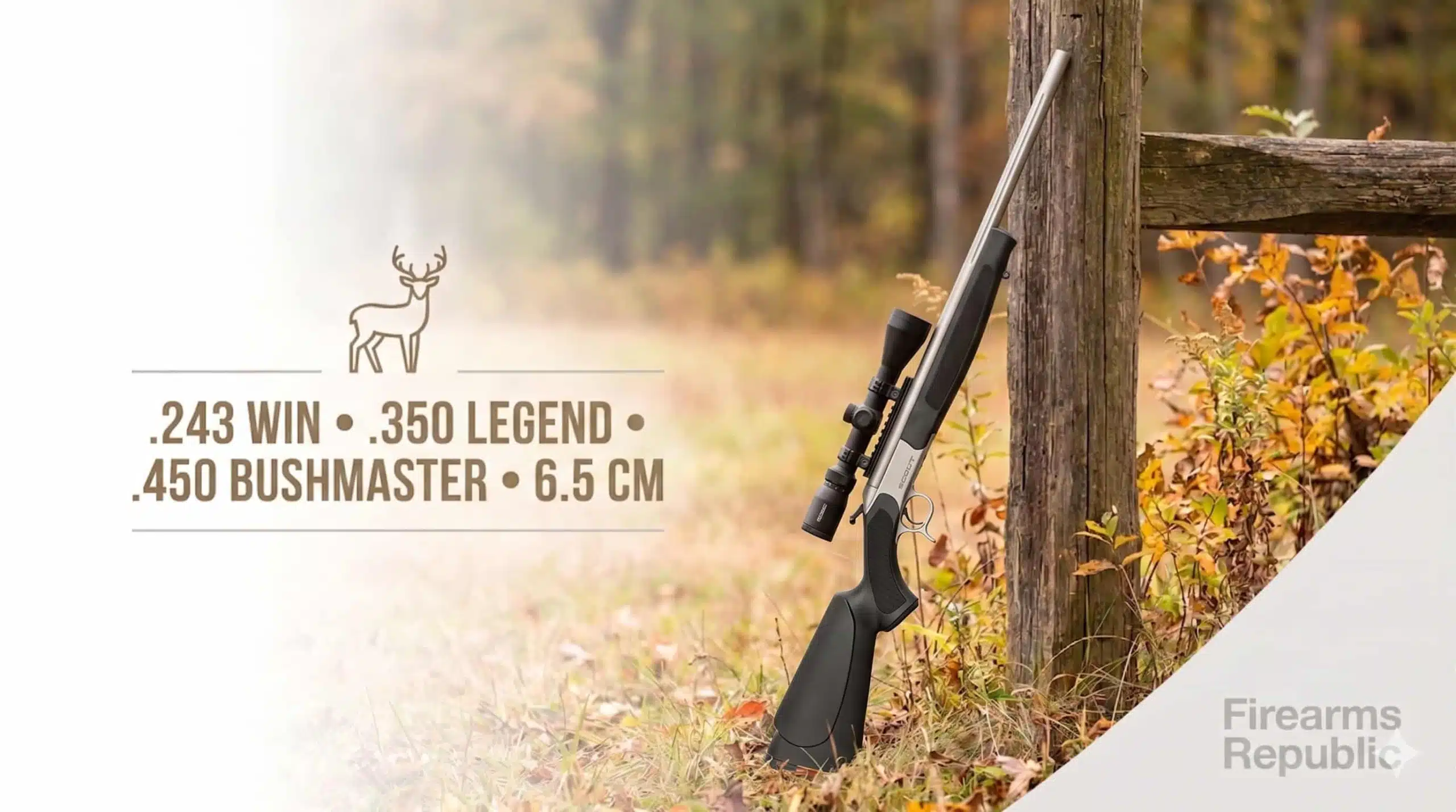
Most deer hunters don’t need a five-shot bolt-action with an adjustable chassis and a $1,200 scope. They need a rifle that’s reliable, accurate at the distances they actually shoot, and won’t break the bank. In that context, the CVA Scout makes more sense than most hunters realize.
The Scout’s break-action single-shot format is a natural fit for whitetail hunting specifically. Whitetail hunting in the Midwest and South is overwhelmingly a one-shot game – you sit a stand, a deer steps into a shooting lane, you shoot once and it’s over. Magazine capacity is irrelevant. Bolt speed is irrelevant. What matters is that the one shot you take is accurate and powerful enough to put the animal down cleanly.
For deer hunting with standard bottlenecked cartridges – .243 Winchester, .308 Winchester, 6.5 Creedmoor, and 7mm-08 Remington – the CVA Scout delivers everything a deer hunter needs at a price that makes a lot of sense. This guide covers how each caliber actually performs from a 20″ Scout barrel, how to set up the rifle for deer season, and which caliber fits which hunter and situation.
Why a Single-Shot for Deer?
Before getting into calibers, the practical case for single-shot deer hunting is worth making directly.
A CVA Scout in .308 Winchester with a quality scope costs $650–$700 total. A comparable bolt-action setup – Ruger American Gen II .308 with a Vortex Crossfire II – runs $850–$900. The Scout saves you $150–$250 and gives up nothing that matters in a whitetail hunting context.
The single-shot also imposes a discipline that experienced hunters often cite as an advantage. Knowing you have one round forces more deliberate shot selection. You wait for the right angle, the right distance, the confident shot. Hunters who switch to single-shots often report fewer marginal shots and cleaner kills over time – not because the rifle is more accurate, but because the shooter is more selective.
There’s also the simplicity argument. A break-action single-shot has essentially no moving parts to fail. No bolt to cycle under pressure, no magazine to fumble with numb fingers in cold weather, no gas system to malfunction. Open, load, close, shoot. Experienced single-shot hunters do this in under five seconds without thinking about it.
The limitation is real: if you want follow-up shots quickly, a single-shot is not the right tool. Hunters who pursue deer in situations where running shots, multiple animals, or difficult recovery are common should use a repeating rifle. For stand hunters, blind hunters, and spot-and-stalk hunters who take deliberate shots at known distances, the Scout is completely appropriate.
The Four Best Deer Calibers in the CVA Scout
.243 Winchester
The .243 Winchester is the traditional youth and new-hunter deer cartridge for a reason. Loaded with 95–100gr hunting bullets, it provides reliable deer performance inside 300 yards with recoil so mild that almost any shooter can handle it comfortably.
From a 20″ CVA Scout barrel:
- Federal 95gr Trophy Bonded Tip: ~2,900 fps, ~1,775 ft-lbs
- Hornady 100gr Interlock: ~2,850 fps, ~1,802 ft-lbs
- Winchester 95gr Ballistic Silvertip: ~2,900 fps, ~1,775 ft-lbs
At those numbers, the .243 Win generates roughly 8–9 ft-lbs of felt recoil in a 6.5-lb rifle – similar to a .350 Legend and significantly less than .308. For a young hunter shooting from a stand who may have limited experience managing recoil, this is genuinely important. A flinching shooter misses deer. A comfortable shooter hits deer.
The .243’s limitation is on deer at the larger end. Mature northern whitetail bucks running 180–200 lbs are at the margin of what the .243 handles well, especially at angles where the bullet must penetrate deeply before reaching vitals. For average whitetail and mule deer in the 100–150 lb range, it’s plenty. For very large deer or quartering-away shots at distance, the heavier calibers in this list are more confidence-inspiring.
Best use: Youth hunters, recoil-sensitive adults, average-sized whitetail and mule deer inside 250 yards. The Scout .243 with a 20″ barrel is arguably the best setup CVA makes for introducing young hunters to centerfire deer rifles.
7mm-08 Remington
The 7mm-08 is one of the most underappreciated deer cartridges in the American market. It sits between .243 and .308 in recoil, uses high-BC 7mm bullets that maintain energy at distance better than .243, and produces terminal performance on deer that is decisive without being overkill.
From a 20″ CVA Scout barrel:
- Hornady 139gr SST: ~2,700 fps, ~2,249 ft-lbs
- Federal 140gr Trophy Bonded: ~2,680 fps, ~2,234 ft-lbs
- Winchester 140gr Power-Point: ~2,660 fps, ~2,199 ft-lbs
Felt recoil is approximately 14–15 ft-lbs in a standard-weight rifle – notably less than .308 and clearly more than .243, but in a comfortable middle ground that most hunters manage without developing bad habits.
The 7mm-08’s bullets have better BC than comparable .30 caliber bullets at the same weight. A 140gr 7mm bullet holds velocity better than a 150gr .308 bullet at the same muzzle velocity, which means the 7mm-08 maintains energy advantage at distance. For shots between 200 and 300 yards on deer – the practical outer limit for most Scout hunters – the 7mm-08 is marginally superior to .308 from the same barrel length.
Best use: Hunters who want more performance than .243 without committing to .308 recoil. The 7mm-08 handles deer-to-elk-sized game cleanly to 300 yards and is one of the best choices for a single rifle that hunts everything from pronghorn to moderate elk country.
For more on the 7mm-08 cartridge, see our 7mm-08 Remington Caliber Guide.
.308 Winchester
The .308 Winchester is the universal hunting cartridge. It works, it’s available everywhere, it’s been proven on every species of North American game, and the ammunition selection is the deepest of any hunting caliber on the market. If you want a single deer rifle that will never present an ammo availability problem anywhere in the country, .308 is the obvious answer.
From a 20″ CVA Scout barrel:
- Federal 168gr Gold Medal Match: ~2,580 fps, ~2,483 ft-lbs
- Hornady 178gr ELD-X: ~2,520 fps, ~2,508 ft-lbs
- Winchester 150gr Power-Point: ~2,700 fps, ~2,428 ft-lbs
- Federal 180gr Trophy Bonded Bear Claw: ~2,450 fps, ~2,399 ft-lbs
The 20″ barrel costs the .308 approximately 70–100 fps compared to a standard 22″ bolt-gun barrel. In hunting terms, this is irrelevant – at 200 yards, the retained energy difference between 22″ and 20″ .308 is less than 100 ft-lbs, which has no practical effect on deer.
Felt recoil is approximately 18–20 ft-lbs in a 7-lb rifle with a standard stock. This is manageable for most adult hunters but noticeable, especially for the smaller-framed or younger. The Scout’s CrushZone recoil pad helps, but .308 in a single-shot break-action remains a more assertive shooting experience than .243 or 7mm-08.
Best use: Hunters who want the universal choice – maximum ammunition availability, flexibility across game species (the same rifle and load that works on deer can be used for hog, black bear, and moderate elk distances), and proven terminal performance. The Scout .308 is also the right choice if you might use the rifle outside deer season for other applications.
For a complete cartridge breakdown, see our .308 Winchester Caliber Guide.
6.5 Creedmoor
The 6.5 Creedmoor has earned its reputation. From a 20″–22″ barrel, it produces a flat trajectory, high-BC bullets that resist wind drift, and terminal performance on deer that equals or exceeds .308 at practical hunting distances – with less recoil.
From a 22″ CVA Scout barrel:
- Hornady 143gr ELD-X: ~2,700 fps, ~2,315 ft-lbs
- Federal 140gr Trophy Bonded: ~2,680 fps, ~2,234 ft-lbs
- Hornady 140gr ELD-M (match): ~2,720 fps, ~2,302 ft-lbs
Felt recoil is approximately 12–13 ft-lbs – noticeably less than .308 at similar muzzle energy. The 6.5 CM’s high-BC 143gr ELD-X bullet retains velocity and energy at distance better than most .30 caliber hunting bullets. At 300 yards, a 6.5 CM 143gr ELD-X is still moving at ~2,280 fps and carrying ~1,650 ft-lbs – more than adequate for clean deer kills.
The Scout .22″ 6.5 Creedmoor is genuinely one of the better long-range deer setups in the platform’s lineup, because the cartridge’s real advantages become apparent past 200 yards where trajectory and wind drift matter. For a hunter who takes occasional shots in the 200–300 yard range on open ground – western deer hunting, agricultural fields, open timber – the 6.5 CM delivers meaningfully better performance than .308 at those distances.
Best use: Hunters who shoot at moderate-to-extended range (150–300 yards), anyone upgrading from .308 who wants reduced recoil with equal or better performance, and hunters who use the same rifle for deer and want to maintain confidence on elk-sized game at distance.
For the full caliber breakdown, see our 6.5 Creedmoor Caliber Guide.
Side-by-Side Comparison at Hunting Distances
| Caliber | Muzzle Energy | Energy at 200 yds | Energy at 300 yds | Recoil | Drop at 200 yds* |
|---|---|---|---|---|---|
| .243 Win 95gr | 1,775 ft-lbs | ~1,350 ft-lbs | ~1,100 ft-lbs | ~8 ft-lbs | -2.8″ |
| 7mm-08 140gr | 2,249 ft-lbs | ~1,750 ft-lbs | ~1,450 ft-lbs | ~14 ft-lbs | -2.3″ |
| .308 Win 168gr | 2,483 ft-lbs | ~1,870 ft-lbs | ~1,500 ft-lbs | ~19 ft-lbs | -3.1″ |
| 6.5 CM 143gr | 2,315 ft-lbs | ~1,850 ft-lbs | ~1,650 ft-lbs | ~12 ft-lbs | -2.1″ |
*Drop calculated with 100-yard zero from respective Scout barrel lengths
The 6.5 Creedmoor’s performance advantage at distance is clear in the numbers. At 300 yards, it retains more energy than .308 despite lower muzzle energy, and it hits flatter than any other cartridge in this group. For deer hunters who regularly shoot past 200 yards, 6.5 CM is the most capable option in the Scout lineup.
For inside 200 yards – which covers most timber and agricultural hunting – all four calibers are entirely adequate. The choice between them at these distances comes down to recoil tolerance and ammo cost.
Optics for Deer Hunting with the CVA Scout
The right optic depends on where you’re hunting and the distances involved.
Timber and agricultural hunting inside 150 yards:
A fixed 4× or a low-power variable (1–4× or 2–7×) is ideal. The Vortex Crossfire II 2–7×32 ($180) is a practical, affordable choice that handles any deer hunting distance. A Leupold VX-Freedom 2–7×33 ($280) is a step up in glass quality for hunters who want better light transmission in low-light morning and evening shooting situations.
Open country, agricultural fields, moderate long-range (200–300 yards):
A 3–9×40 or 4–12×40 gives enough magnification to shoot confidently at 250 yards while still being usable at 50 yards. Vortex Crossfire II 3–9×40 ($180) is the entry-level workhorse. Vortex Diamondback 4–12×40 ($300) for better glass and more magnification range.
Important for all Scout setups: Get proper eye relief. The Scout’s break-action geometry places the receiver differently than a bolt-gun, and scope position needs to be set before you’re in the field. Verify eye relief with the rifle in a hunting-ready position – not at a bench. The CrushZone recoil pad helps, but eye relief errors on a hard-recoiling caliber like .308 are an unpleasant experience.
Zeroing the Scout for Deer Hunting
For deer hunting inside 200 yards:
Zero at 100 yards. From a 100-yard zero, all four calibers in this guide stay within ±3″ from muzzle to 200 yards. That’s within the vital zone of a deer at every distance you’re likely to shoot without holding over. Past 200 yards, use known drop data from your specific load.
For western hunting or open-field shots out to 300 yards:
A 200-yard zero leaves all four calibers shooting approximately -6″ to -8″ at 300 yards – which requires a modest holdover but keeps things simple at 150–200 yards where most shots happen.
Cold bore first-shot data: The Scout benefits from knowing where your cold bore first shot prints relative to your fouled-bore group. Take three cold bore shots across multiple range sessions and note the average deviation. For most hunting applications, a clean and slightly fouled bore produce nearly identical impacts, but knowing for certain prevents surprises on opening morning.
Hunting-Specific Setup Tips
Sling: Add one. The Scout’s sling swivel studs accept any standard sling, and carrying a rifle on a sling through timber is significantly less tiring than in-hand for multi-hour approaches. A simple two-point nylon sling costs $15 and immediately makes the rifle more practical in the field.
Practice the reload: This is the only aspect of single-shot hunting that requires specific practice. From your normal shooting position – standing, sitting, kneeling – practice opening the action, removing the spent case, inserting a fresh round, and closing the action. It should be a smooth 4–6 second sequence. Practice until it’s automatic, then practice some more. A fumbled reload at the wrong moment is a missed opportunity.
Know your shooting positions: Stand hunters and blind hunters rarely need anything beyond a sitting or prone rest shot. If you hunt in situations where unsupported shots are possible – still-hunting in timber, posting at field edges – practice offhand and kneeling shots with the Scout before the season. The break-action balance is slightly different from a bolt-gun, and a few range sessions establish the right feel.
CrushZone pad note for .308 hunters: The factory CrushZone recoil pad is adequate for field use, but hunters who practice extensively with .308 may want to add a slip-on recoil pad like the Pachmayr Decelerator ($20–$25) for range sessions. It protects your shoulder during extended shooting and won’t affect field performance.
Best Deer Hunting Ammo by Caliber
For .243 Winchester:
- Hornady 95gr SST: ~$25/box – best all-around choice, good expansion on deer
- Federal 95gr Trophy Bonded Tip: ~$35/box – premium controlled expansion, better penetration on large deer
- Winchester 80gr Deer Season XP: ~$22/box – economical, good terminal performance on average deer
For 7mm-08 Remington:
- Hornady 139gr SST: ~$28/box – top choice for most 7mm-08 hunters
- Federal 140gr Trophy Bonded: ~$38/box – premium option for larger deer or longer shots
- Winchester 140gr Ballistic Silvertip: ~$30/box – accurate, consistent terminal performance
For .308 Winchester:
- Hornady 178gr ELD-X: ~$32/box – excellent long-range deer load with controlled expansion
- Federal 150gr Power-Shok: ~$22/box – economical hunting load, reliable terminal performance
- Winchester 150gr Deer Season XP: ~$24/box – purpose-designed whitetail load at reasonable price
- Federal 168gr Trophy Bonded Bear Claw: ~$45/box – if you’re also hunting hog or black bear
For 6.5 Creedmoor:
- Hornady 143gr ELD-X: ~$32/box – the go-to deer and elk load for 6.5 CM
- Federal 140gr Trophy Bonded: ~$38/box – premium controlled expansion
- Winchester 129gr Deer Season XP: ~$26/box – affordable option for regular deer hunting
CVA Scout vs Entry-Level Bolt-Actions for Deer
The honest comparison: a CVA Scout in .308 with a Vortex Crossfire II costs roughly the same as a Ruger American Gen II .308 with the same scope. Both will kill deer reliably inside 200 yards.
The bolt-action wins on: magazine capacity (4 rounds vs 1), aftermarket upgrade path (Ruger American has stocks, triggers, chassis), and the ability to shoot multiple rounds quickly at the range for load development. See our Ruger American Guide for a full breakdown of that platform.
The Scout wins on: simplicity, lower parts count, mechanical reliability in extreme conditions, and – importantly – the Bergara barrel quality that delivers accuracy equal to or better than most entry-level bolt-guns out of the box.
For deer hunting specifically, the Scout is a legitimate alternative to any entry-level bolt-action. The practical hunting performance difference is negligible. Buy the Scout if you value simplicity and the single-shot hunting experience. Buy the bolt-action if you want magazine capacity, load development capability, or an upgrade path.
FAQ
Q: Is the CVA Scout .243 enough for big whitetail bucks?
A: For average whitetail (100–150 lbs) inside 200 yards with good shot placement, yes. For mature northern bucks running 180–200 lbs, the .243 is marginal – especially on quartering-away shots that require deep penetration. Use premium controlled-expansion bullets like Federal Trophy Bonded, limit shots to inside 200 yards, and aim for the heart/lung zone. If you regularly encounter very large deer, consider 7mm-08 or .308 for more margin.
Q: Does the 20″ barrel hurt .308 performance meaningfully for deer hunting?
A: No. The 20″ barrel costs approximately 70–100 fps vs a 22″ barrel in .308. At 200 yards, the retained energy difference is under 100 ft-lbs – completely irrelevant for deer hunting. The Scout .308 from a 20″ barrel is fully capable to 300 yards on deer-sized game.
Q: Why choose 6.5 Creedmoor over .308 in a Scout for deer?
A: If your shots are consistently inside 150 yards, there’s no compelling ballistic reason. The .308 has more muzzle energy and deeper bullet selection at similar prices. Past 200 yards, the 6.5 CM’s flatter trajectory, better BC bullets, and lower recoil become meaningful advantages. Choose 6.5 CM if you hunt at moderate-to-long range; .308 if you want maximum ammunition availability and flexibility.
Q: Can the CVA Scout in .308 handle elk as well as deer?
A: Yes, inside its practical range. The Scout .308 with 178gr ELD-X or 180gr Trophy Bonded Bear Claw delivers adequate energy and penetration for elk inside 250 yards with a well-placed shot. It’s not a 400-yard elk rifle – the trajectory and energy retention at extended range favor dedicated elk cartridges like 6.5 PRC or 7mm PRC. For opportunistic elk hunting in the same trip as deer, the Scout .308 covers both adequately. See our Elk Hunting Rifles Guide for more on elk-specific setups.
Q: What’s the best caliber in the Scout for a hunter who does everything?
A: .308 Winchester for maximum ammo availability and flexibility across game. Or 6.5 Creedmoor if you’re comfortable with the cartridge and want slightly better long-range performance with less recoil. Both work on every deer and black bear in North America. The choice between them is a matter of preference, not capability.