 Maksym Kovaliov
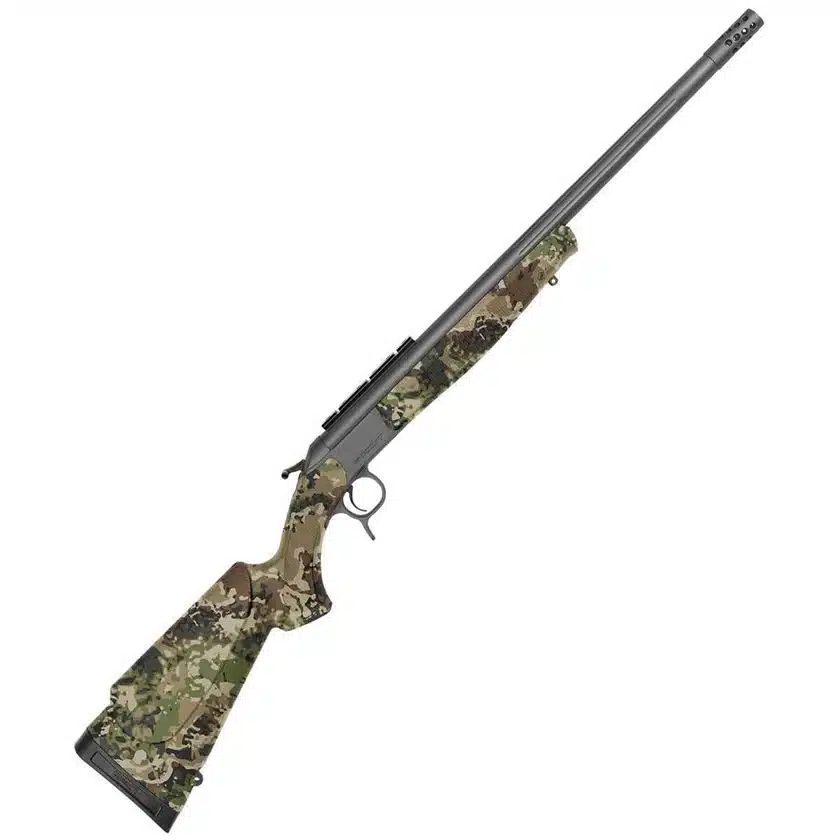
Most hunting rifles are designed to be carried to a specific location and used. The CVA Scout Takedown is designed to go everywhere else – the truck cab, the boat, the bug-out bag, the back of the ATV, the camp kitchen where a rifle needs to be accessible without taking up the space of a full-length firearm.
The Takedown is a variant of the standard Scout platform with one key addition: tool-free barrel disassembly. The barrel separates from the stock and receiver in seconds without tools, reducing the rifle to two pieces that pack into a bag, case, or vehicle storage compartment that a conventional rifle wouldn’t fit. Reassembly is equally fast, and zero is maintained between sessions – a critical feature that separates the Takedown from earlier generations of takedown-style hunting rifles.
This review covers what the Takedown actually is, how it differs from the standard Scout, which calibers make the most sense for its intended applications, how it performs as a suppressor host, and whether it’s worth the modest premium over a standard Scout.
What Makes the Takedown Different
The CVA Scout Takedown’s core feature is the quick-detach barrel system. The forearm unlocks from the action via a simple lever or release mechanism, the barrel slides free, and the rifle separates into two compact pieces. No tools. No loosening screws. The entire process takes under 10 seconds once you’ve done it a few times.
Reassembly is the reverse: slide the barrel assembly back into the receiver, lock the forearm, and the rifle is back together. Critically, headspace and barrel alignment are mechanically fixed by the design – the barrel returns to the same position every time, so zero remains consistent between assembly cycles. This is not guaranteed with some older takedown designs where user error in reassembly could shift zero.
Physical dimensions (assembled):
- 20″ barrel configuration: approximately 40.5″ overall length
- 22″ barrel configuration: approximately 42.5″ overall length
- Weight: 6.5–6.8 lbs depending on caliber configuration
Physical dimensions (disassembled):
- Barrel assembly: approximately 24–26″ depending on configuration
- Stock/receiver assembly: approximately 14″
- Both pieces fit in a standard 28″ soft rifle case with room for accessories
For comparison, a standard Scout V2 in .308 is 42.5″ overall and cannot be broken down without tools. The Takedown in the same caliber, broken into two pieces, fits in a duffel bag or truck storage compartment where a full-length rifle won’t.
Ported Barrel vs Threaded Muzzle
This is the most important practical distinction within the Takedown lineup, and it determines whether the rifle works as a suppressor host.
Most CVA Scout Takedown configurations ship with a ported barrel. The ports – small holes near the muzzle – redirect propellant gases upward and to the sides, reducing felt recoil and muzzle rise. The effect is noticeable, particularly in .45-70 or .450 Bushmaster configurations. The trade-offs: the ported barrel cannot accept a suppressor (threading a ported barrel is not recommended as the gases vent before the suppressor), and the muzzle blast is louder at the shooter’s ear as gases redirect rearward.
Some Takedown configurations ship with a threaded muzzle (typically 5/8×24 for .30 caliber and larger, 1/2×28 for .223 class). These accept suppressors and standard muzzle devices. If suppressor use is your primary reason for buying the Takedown, verify the specific configuration you’re ordering has a threaded muzzle, not a ported barrel. This varies by retailer and model year.
The standard Scout (non-Takedown) is more consistently available with a threaded muzzle and is generally the better choice if suppressor hunting is the main application. The Takedown’s compact storage advantage matters most in truck gun and camp rifle roles.
Best Calibers for the Takedown Platform
The Takedown is available in a subset of the full Scout caliber lineup. Current availability varies by retailer, but these are the most common configurations:
.350 Legend
The .350 Legend Takedown is arguably the most practical configuration in the lineup. The 20″ barrel delivers approximately 2,100–2,200 fps with 150–170gr hunting bullets, and the .350 Legend’s straight-wall compliance makes this rifle legal for deer hunting during restricted seasons in Ohio, Michigan, Indiana, and Iowa.
The combination of short overall length (40.5″ assembled), fast disassembly for vehicle storage, low recoil, and straight-wall legality makes the .350 Legend Takedown a genuinely versatile truck-and-hunt rifle. A farmer who covers large acreage and wants a rifle accessible from the cab for opportunistic coyote or deer control, a hunter who travels across multiple states with different regulations, or anyone who wants a legal deer rifle that fits in a bag – the .350 Legend Takedown covers all of these.
For suppressed use: the .350 Legend is an excellent suppressor host. Subsonic .350 Legend loads exist (Inceptor Sport Utility 147gr at ~1,050 fps), and with a suppressor, the report is dramatically reduced. For a hunting configuration optimized for sound suppression, verify you have a threaded muzzle configuration before ordering.
.308 Winchester
The .308 Takedown is the most universally useful configuration for hunters who want one rifle that handles any North American game inside 250 yards. Same caliber considerations as the standard Scout .308 apply – see our CVA Scout Deer Hunting Guide – with the added benefit of compact packability.
From a 20″ barrel, the .308 Takedown delivers approximately 2,580 fps with 168gr loads – adequate for deer and elk inside 250 yards, usable for hog at moderate range. The trade-off vs the standard Scout is minimal: the Takedown’s barrel design adds negligible weight and the accuracy is comparable.
The .308 Takedown makes particular sense as a camp rifle – a second rifle at elk camp that serves as a utility gun, a backup for equipment failures, or an emergency tool that can be stored without taking up valuable gear space.
.450 Bushmaster
The .450 Bushmaster Takedown brings maximum straight-wall power in a packable format. For Midwest hunters who specifically need .450 Bushmaster compliance and want the Takedown’s storage advantages, this is the configuration.
The ported barrel on most .450 Bushmaster Takedown configurations is genuinely useful here – .450 Bushmaster generates significant recoil in a light single-shot, and the ports reduce felt recoil meaningfully. The trade-off for suppressor capability is real, but most .450 Bushmaster hunters aren’t suppressor hunting anyway.
.44 Remington Magnum
The .44 Magnum Takedown in 22″ barrel configuration is an interesting niche option. Running .44 Mag rifle loads – significantly more powerful than pistol loads of the same caliber – from a 22″ barrel produces approximately 1,800–2,000 fps with 240–300gr bullets. This is adequate for deer inside 150 yards, capable for large hogs, and manageable in recoil for most hunters.
The .44 Mag Takedown’s unique application is hunting in areas where rifle regulations are restrictive but pistol-caliber rifles are permitted. Some states and national forests have specific regulations; the .44 Magnum straddles a useful legal line in certain jurisdictions.
As a Truck Gun
“Truck gun” is informal language for a rifle kept in a vehicle for opportunistic use – pest control, emergency dispatch of wounded game encountered while scouting, protection in remote areas, or general utility in agricultural settings. The CVA Scout Takedown is one of the better production options for this application.
Why it works as a truck gun:
The disassembled Takedown fits in a 28″ soft case that slides under a truck seat, behind the cab seats of a pickup, or in the bed toolbox without taking up meaningful space. Assembled in under 10 seconds when needed, it presents a functional rifle immediately.
The Scout’s stainless steel barrel resists the temperature cycling and humidity variation of vehicle storage better than blued steel alternatives. A rifle stored in a truck cab in Texas in August experiences a brutal thermal environment; stainless and synthetic construction handles this without the rust concerns of traditional blued rifles.
Caliber choice for truck gun use:
.308 Winchester is the most practical choice for a general-purpose truck gun. Universal ammunition availability, adequate performance on anything from coyotes to elk, and no legal restrictions that would require a specific caliber selection. A box of Federal .308 is available at every Walmart in rural America.
.350 Legend is the right choice for straight-wall states where the truck gun doubles as a legal deer rifle during restricted seasons.
Storage considerations:
Store the Takedown disassembled for long-term vehicle storage – the shorter pieces are easier to secure and less visible. Most truck gun use involves opportunistic shots, not immediate defensive deployment, so the 10-second assembly time is not a meaningful limitation.
Check your state’s laws on loaded firearms in vehicles. The single-shot Takedown’s manual of arms – open action, insert round, close, cock hammer, shoot – means it can be stored legally unloaded and made ready quickly, which is the appropriate approach for vehicle storage in most states.
As a Survival and Camp Rifle
The Takedown’s packability makes it more viable than a standard rifle for survival kit and camp utility applications. The assembled rifle handles any hunting or utility task a conventional rifle would. The disassembled format fits in spaces where a conventional rifle cannot go.
Survival application:
A disassembled Scout Takedown in .308 or .350 Legend fits in a large backpack, duffel bag, or emergency kit. For hunters, ranchers, and outdoorspeople who want a centerfire rifle available in the backcountry without the bulk of a conventional rifle, the Takedown addresses a real gap.
The .22 LR is the traditional survival rifle caliber for ammunition economy, but the Scout Takedown is not available in .22 LR. For actual survival scenarios where ammo weight matters over long distances, this is a genuine limitation. The Takedown fills the role of a compact, packable hunting rifle rather than a dedicated lightweight survival tool.
Camp rifle application:
At a remote hunting camp, a second rifle is valuable insurance. Equipment failures happen. A hunting partner without a working rifle represents a lost tag and a wasted trip. A disassembled Takedown in a soft case weighs under 8 lbs with a scope and takes up minimal space in a camp kit.
The .308 is the right camp rifle caliber for versatility. It covers the camp’s needs for any large game hunting the group is pursuing while maintaining the caliber flexibility to be used across multiple platforms if needed.
As a Suppressor Host
The Scout Takedown with a threaded barrel configuration is a capable suppressor host. The break-action single-shot design is actually ideal for suppressor use for a mechanical reason: there is no gas system cycling to deal with. In a semi-automatic rifle, suppressors must be tuned to the gas system – too little back-pressure and the bolt doesn’t cycle; too much and the rifle over-gases. In a single-shot break-action, none of this applies. Attach a compatible suppressor, shoot, extract, reload. No tuning required.
Best suppressor caliber pairings:
.350 Legend subsonic – One of the most practical suppressed hunting configurations available. Inceptor 147gr Sport Utility at approximately 1,050 fps produces a report that is hearing-safe unsuppressed and genuinely quiet with a suppressor. The .350 Legend’s straight-wall legality makes this setup legal for deer during restricted seasons in multiple states. A suppressed .350 Legend Takedown in an enclosed hunting blind is an exceptionally quiet, effective deer hunting setup.
.300 Blackout – The Scout is not currently listed in .300 Blackout, but if CVA adds it, this would be the ideal suppressor configuration. .300 BLK subsonic was designed specifically for suppressed single-shot use. Check current available configurations.
.308 Winchester – Suppressed .308 is not hearing-safe unsuppressed, but a suppressor reduces the report from roughly 170 dB to approximately 136–140 dB – below the threshold of immediate hearing damage for a single shot and dramatically more comfortable for extended sessions. For a camp or truck gun that will occasionally be used close to structures, vehicles, or other people, the reduced blast is a genuine practical benefit.
For suppressor selection and legal process, see our Suppressor Buyer’s Guide.
Takedown vs Standard Scout: Which Should You Buy?
The Takedown commands a modest premium over the standard Scout V2 – typically $30–$60 more depending on caliber and retailer. That price difference is almost never the deciding factor. The actual decision comes down to whether the takedown capability matters for your specific use case.
Buy the Takedown if:
You need to store the rifle in a vehicle, boat, ATV, or other confined space where a 42″+ rifle won’t fit. The Takedown’s packability is the entire value proposition.
You travel across state lines with a rifle and want something that fits in checked baggage or vehicle storage without dedicated rifle case management.
You want a camp backup rifle that doesn’t take up meaningful gear space.
Buy the standard Scout if:
You want a threaded muzzle for suppressor use and can’t confirm the Takedown configuration you’re ordering has one. The standard Scout is more consistently available with a threaded barrel.
You’re primarily hunting from a stand or blind where packability doesn’t matter and the standard Scout’s slightly simpler design is preferable.
You want the widest caliber selection – the standard Scout lineup covers more calibers than the Takedown variant.
FAQ
Q: Does the CVA Scout Takedown maintain zero after disassembly and reassembly?
A: Yes, in normal use. The barrel-to-receiver alignment is mechanically fixed by the design, and the headspace is set at the factory. Multiple owners report consistent zero maintenance across hundreds of assembly cycles. That said, it’s good practice to confirm zero with a few rounds at the start of each season, particularly if the rifle has been stored assembled for extended periods or subjected to significant temperature variation.
Q: Is the CVA Scout Takedown legal on commercial flights as checked baggage?
A: A disassembled Takedown in a locked hard case complies with TSA and airline regulations for checked firearms in the same way a conventional rifle does. The disassembled format makes it easier to fit within standard luggage size limits. Always check current TSA and airline regulations before traveling – rules change, and specific airline policies vary.
Q: What is the accuracy difference between the Takedown and standard Scout?
A: Negligible in practice. Multiple owners report comparable groups from both configurations with the same ammunition. The barrel is the primary accuracy driver in both cases, and both use the same Bergara-manufactured barrels. A slight variation may exist if the barrel-to-receiver lockup introduces any inconsistency, but reported real-world accuracy from Takedown owners is consistent with standard Scout performance – typically 0.8–1.2 MOA with quality factory loads.
Q: Can I use the CVA Scout Takedown for home defense?
A: The Takedown’s assembly requirement makes it less immediately deployable than a conventional rifle, and the single-shot limitation is a significant disadvantage in a defensive scenario. For home defense, see our Home Defense Rifle Guide for more appropriate options.
Q: Does the ported barrel reduce accuracy compared to a threaded muzzle?
A: Not meaningfully. The ports are near the muzzle and don’t affect rifling or the projectile’s passage through the barrel. The primary effect of the ported barrel is on felt recoil and muzzle blast direction, not accuracy. Groups from ported and non-ported Scout barrels in the same caliber are comparable in independent testing.
Related Guides
- CVA Scout Complete Guide
- CVA Scout for Straight-Wall Deer Hunting States
- CVA Scout for Deer Hunting
- Suppressor Buyer’s Guide
- Home Defense Rifle Guide
- Small Game Hunting Rifles
- .300 Blackout Caliber Guide