 Maksym Kovaliov
The “one rifle for everything” question comes up constantly in hunting forums, and it deserves a straight answer instead of the usual hedge. A single bolt-action rifle in 6.5 Creedmoor, .308 Winchester, or .30-06 Springfield, scoped with a quality 3-9x or 2-10x optic, can handle 95% of North American hunting from whitetail to elk to black bear – and do it well. The remaining 5% involves situations where a true specialist rifle wins: dangerous game requiring heavy calibers, long-range varminting requiring flat-shooting .22-centerfire cartridges, or deep backcountry where every ounce is scrutinized. This guide is for the hunter who wants one honest, capable, no-compromise rifle – and it’s going to give you specific recommendations rather than a list of 20 options that avoids the question.
What “One Rifle” Actually Means
Before getting into specific models, it’s worth defining what we’re solving for. A true one-rifle solution has to satisfy three demands simultaneously: it has to be accurate enough for ethical shots at the distances you actually shoot, powerful enough for the largest game you’ll realistically pursue, and light enough that you’ll actually carry it all day.
Most hunters overestimate how specialized their needs are. The majority of American hunters pursue whitetail deer, and of those, a significant portion occasionally draw elk tags or travel for mule deer or pronghorn. That’s the core use case – and it’s well-served by a narrow band of cartridges and rifle configurations. The mistake hunters make is optimizing for the one extreme scenario (the 400-yard elk shot in Colorado) at the expense of the 95% (the 80-yard whitetail in Ohio hardwoods). A good one-rifle solution doesn’t optimize for the outlier – it handles the outlier competently while excelling at the everyday.
The practical parameters for a one-rifle hunting solution:
Caliber needs to be adequate for deer-sized game at 300 yards and elk-sized game at 200 yards. This defines a window roughly bounded by .243 Winchester on the light end (marginal for elk) and .300 Winchester Magnum on the heavy end (unnecessary recoil for whitetail). The sweet spot – .308 Winchester, 6.5 Creedmoor, .30-06 Springfield, 7mm-08 Remington, and the newer 7mm PRC – sits comfortably inside this window.
Weight should stay under 8 lbs scoped. Above that, the rifle becomes a burden on long western hunts. Below 6.5 lbs, recoil management gets harder and accuracy under field conditions can suffer. The 7–7.5 lb scoped range is the practical optimum for all-day carry with meaningful performance.
Barrel length of 22–24 inches is the right range. Short barrels (18–20″) sacrifice velocity you need for ethical shots at distance. Long barrels (26″+) add weight and length without meaningful performance gains for hunting use.
The Calibers: Which One for “Everything”?
This is where most guides hedge and recommend all five cartridges equally. Here’s the honest answer: 6.5 Creedmoor and .308 Winchester are the two best choices for a one-rifle hunting solution in 2025, with .30-06 Springfield as a close third for hunters who want more margin on elk and bear.
6.5 Creedmoor – The Best Answer for Most Hunters
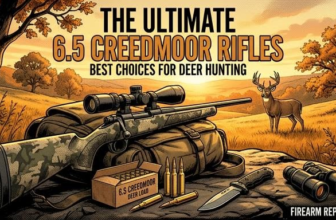
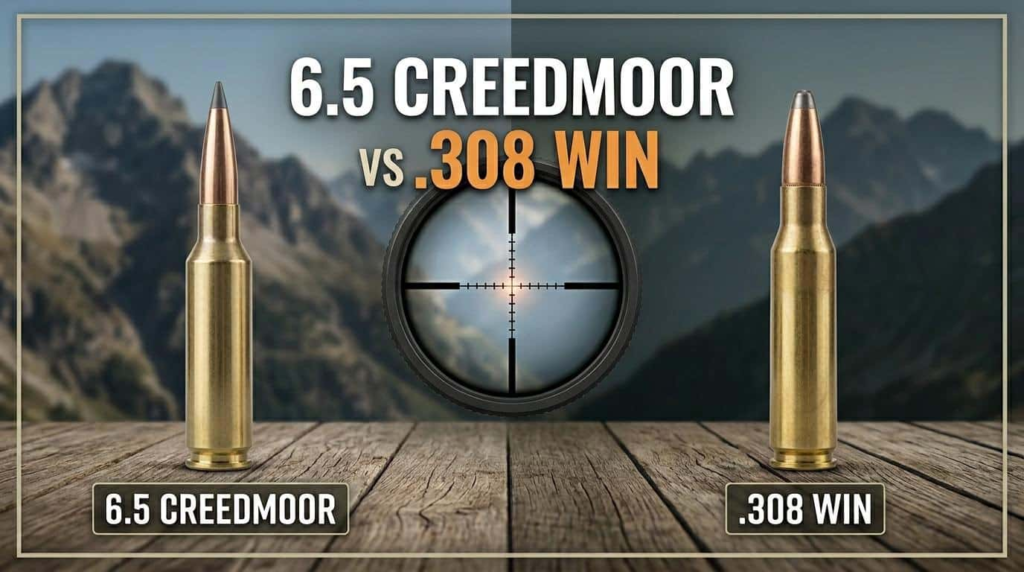
A 6.5 Creedmoor pushing a 143gr ELD-X at 2,700 fps generates 2,315 ft-lbs at the muzzle and retains 1,820 ft-lbs at 200 yards – well above the 1,500 ft-lbs commonly cited as the minimum for elk-sized game. The cartridge’s high-BC bullets (.625 for the 143gr ELD-X) drift less in wind and retain velocity better at distance than the .308’s typical hunting bullets. Recoil in a 7.5-lb rifle is around 13 ft-lbs – comfortable for all-day shooting and manageable for recoil-sensitive hunters. And factory ammunition from Hornady, Federal, and Nosler is consistently accurate, widely available, and has evolved to include purpose-built hunting loads (the ELD-X and AccuBond lines) that expand reliably across a wide velocity range.
The 6.5 CM’s one legitimate limitation is at the heavy end of North American game. For brown bear, bison, or moose in tight brush where a follow-up shot must stop a charge, you want something with more bullet weight and frontal diameter. For the realistic hunting scope of most American hunters – whitetail, mule deer, elk, black bear, pronghorn – the 6.5 CM is genuinely sufficient. See our 6.5 Creedmoor Caliber Guide for deeper ballistic analysis.
.308 Winchester – The Proven Standard
The .308 has 60+ years of North American hunting behind it, and there’s good reason it became the standard. A 180gr Nosler Partition at 2,620 fps generates 2,743 ft-lbs at the muzzle – about 18% more energy than the 6.5 CM at comparable ranges. In thick brush where shots are inside 150 yards and bullet construction matters more than BC, the heavier .30-caliber bullet retains mass and drives deep. For hunters who regularly pursue elk, black bear, and occasionally coastal brown bear in the same season, the .308’s extra energy is meaningful.
The trade-off is real: the .308 drifts more in wind at long range (lower BC bullets), generates more recoil (16–18 ft-lbs in a 7.5-lb rifle), and drops faster past 300 yards. For shots inside 300 yards on any North American game short of dangerous brown bear, the performance difference between 6.5 CM and .308 is marginal in practice. For shots past 300 yards in wind, the 6.5 CM is objectively better. For detailed comparison, see our 6.5 Creedmoor vs .308 Winchester guide.
.30-06 Springfield – The Original One-Rifle Answer
The .30-06 gives you everything the .308 does with 10–12% more velocity from a longer case – a 180gr bullet at 2,700 fps for 2,913 ft-lbs at the muzzle. That margin matters most on large game at distance. If you regularly hunt elk in big country with shots past 250 yards, the .30-06 provides genuine confidence that the .308 doesn’t quite match. The downside: it requires a long-action rifle, which adds 4–6 oz versus a short-action .308 or 6.5 CM, and ammunition is less universally accurate in budget rifles than the short-action cartridges.
For a dedicated one-rifle solution that skews toward larger game, the .30-06 is the traditional answer and still a good one.
What About 7mm PRC, 6.5 PRC, .300 Win Mag?
These are excellent cartridges but not optimal one-rifle choices. The 7mm PRC and 6.5 PRC provide genuine advantages at 400+ yards and on larger game, but they generate significantly more recoil (22–28 ft-lbs), are harder on barrels, and require more expensive ammunition. The .300 Win Mag is the right answer when you’re hunting grizzly country or consistently shooting elk at 400+ yards – not when you want one rifle for everything. If you want to go deeper on the magnum options, our 7mm PRC Caliber Guide and .300 Win Mag Caliber Guide cover the trade-offs in detail.
The Rifles: Best One-Rifle Platforms
Tikka T3x Lite – The Best Overall One-Rifle Choice
Price: $875–$950 street Weight: 6.1 lbs (bare rifle) Calibers: 6.5 CM, .308 Win, .30-06, 7mm-08, and 15+ others Barrel: 22.4″ standard Trigger: Single-stage adjustable 2–4 lbs, factory set ~2.5 lbs Accuracy: Sub-MOA with quality ammunition
The Tikka T3x Lite is the one-rifle answer for the majority of North American hunters. At 6.1 lbs bare and typically 7.5–7.8 lbs scoped, it’s genuinely lightweight for all-day carry without crossing into the sub-6-lb ultralight category where recoil management suffers. The factory trigger breaks at 2.5 lbs with minimal creep – it’s genuinely good without immediate replacement. The three-lug 70-degree bolt cycles faster and smoother than most bolt-actions at any price. The synthetic stock is weather-resistant, the action is consistent, and accuracy is reliably sub-MOA with quality hunting loads.
The Tikka’s limitation is its proprietary magazine system – it doesn’t accept AICS-pattern magazines, which limits aftermarket flexibility if you eventually want to build it into a precision rifle. For a dedicated hunting rifle, that’s not a relevant concern. The T3x Lite’s barrel is 22.4″ and the overall rifle is trim – it handles naturally in the field. In 6.5 Creedmoor, this is the closest thing to a single correct answer for the one-rifle question.
Ruger American Gen II – Best Value One-Rifle
Price: $600–$700 street Weight: 6.3 lbs (bare rifle) Calibers: 6.5 CM, .308 Win, .30-06, 7mm-08, and others Barrel: 22″ threaded Trigger: Marksman Adjustable, 3–5 lbs Accuracy: Sub-MOA guarantee
At $650, the Ruger American Gen II punches well above its price. The AICS-compatible magazine system is a genuine advantage over the Tikka – it opens the door to 10-round magazines and broader aftermarket compatibility if your needs evolve. The factory-threaded barrel means suppressor-ready out of the box, which matters increasingly as suppressor adoption grows for hunting. The Marksman adjustable trigger improves with user adjustment; most hunters set it to 3–3.5 lbs and find it serviceable, though it won’t match the Tikka’s factory pull quality.
For hunters who want to stay under $700 all-in on the rifle and still have a legitimate sub-MOA hunting platform in 6.5 Creedmoor or .308, the Gen II is the answer. It leaves more budget for optics, which is where the real performance gains are on a hunting rifle. See our Ruger American Complete Guide for a deeper look at the platform.
Bergara B-14 Hunter – Best Mid-Range One-Rifle
Price: $950–$1,050 street Weight: 7.0 lbs (bare rifle) Calibers: 6.5 CM, .308 Win, .30-06, .300 Win Mag, and others Barrel: 22″ or 24″ depending on caliber Trigger: Two-stage Bergara Performance Trigger, ~3 lbs Accuracy: Sub-MOA guarantee (.5 MOA typical)
The Bergara B-14 Hunter is what you buy when you want the best of both worlds: a hunting-weight rifle with accuracy that approaches precision-rifle territory. The B-14’s action is built on a Remington 700 footprint, which means the entire ecosystem of aftermarket triggers, stocks, chassis, and accessories fits it. If you start with a hunting rifle and eventually want to configure it for long-range precision work, the B-14 Hunter is a better platform to grow into than either the Tikka or the Ruger American.
At 7.0 lbs bare and roughly 8.5 lbs scoped with a mid-range optic, it’s at the upper edge of comfortable carry weight for all-day western hunting. The Bergara Performance Trigger is genuinely good from the box. The Spanish-manufactured barrel is consistently accurate – most B-14 Hunters produce 0.5–0.7 MOA groups with quality ammunition, which is better than necessary for hunting but leaves margin for long shots. The B-14 Hunter in 6.5 Creedmoor or .30-06 is a rifle you won’t outgrow. See our Bergara B-14 Series Guide for full platform details.
Browning X-Bolt Hunter – Best Fit and Finish, Premium Tier
Price: $900–$1,050 street Weight: 6.5 lbs (bare rifle) Calibers: 6.5 CM, .308 Win, .30-06, .300 Win Mag, and 20+ others Barrel: 22″ or 26″ free-floating Trigger: Feather Trigger, 3.5 lbs factory Accuracy: Sub-MOA guarantee
The Browning X-Bolt is the choice for hunters who want the best combination of light weight, caliber selection, and fit and finish in the sub-$1,100 price range. The 4-lug rotary bolt provides positive lockup and smooth cycling. The Inflex recoil pad is genuinely effective – the X-Bolt in .30-06 feels softer than competing rifles of similar weight. The free-floating barrel is bedded to the stock, and accuracy is consistently good.
The X-Bolt’s Feather Trigger is the one consistent criticism – it breaks at 3.5 lbs but has more travel than ideal for precision use. For hunting, where shots under field conditions rarely require a hair trigger, it’s adequate. It won’t be the first thing you want to replace. The X-Bolt’s wide caliber availability (including .300 Win Mag and 7mm Rem Mag in the same action family) makes it the natural choice if you think you might eventually want to step up to a magnum for larger game.
Savage 110 Ultralite – Best for Western and Backcountry Hunting
Price: $1,100–$1,250 street Weight: 5.8 lbs (bare rifle) – carbon fiber barrel Calibers: 6.5 CM, .308 Win, .28 Nosler, .30-06, and others Barrel: 22″ or 24″ carbon fiber wrapped Trigger: AccuTrigger, 2.5–6 lbs adjustable Accuracy: Sub-MOA guarantee
If your one-rifle is going into the backcountry for sheep, goat, or high-country elk where every ounce counts after mile 8 at 10,000 feet, the Savage 110 Ultralite changes the calculus. At 5.8 lbs with a carbon fiber-wrapped barrel, it’s genuinely lightweight without sacrificing a 22–24″ barrel’s velocity. The AccuTrigger is the best factory adjustable trigger in the budget/mid-range market – set to 2.5 lbs, it rivals many aftermarket options. The carbon-fiber wrapped barrel also stiffens the barrel profile, which contributes to consistent accuracy even as the barrel warms up.
The trade-off is price ($1,100–$1,250) and recoil – a 5.8-lb rifle in 6.5 Creedmoor generates noticeably more felt recoil than a 7.5-lb platform, and in .300 Win Mag it requires a good brake or pad to shoot comfortably. But for the hunter who covers serious miles in serious terrain, dropping 1.5 lbs off your rifle has a compounding effect on the whole pack. This is the one-rifle choice for backcountry-first hunters. For more context on this use case, see our Mountain / Backcountry Hunting Rifles guide.
Comparison: One-Rifle Platforms
| Rifle | Price | Bare Weight | Best Caliber | Trigger | Aftermarket | Best For |
|---|---|---|---|---|---|---|
| Tikka T3x Lite | $900 | 6.1 lbs | 6.5 CM | Excellent | Limited | Best overall |
| Ruger American Gen II | $650 | 6.3 lbs | 6.5 CM / .308 | Good | AICS / Solid | Best value |
| Bergara B-14 Hunter | $1,000 | 7.0 lbs | 6.5 CM / .30-06 | Very good | Rem 700 | Grow-into platform |
| Browning X-Bolt Hunter | $975 | 6.5 lbs | .30-06 / .300 WM | Good | Moderate | Fit, finish, caliber variety |
| Savage 110 Ultralite | $1,175 | 5.8 lbs | 6.5 CM | Excellent | Savage 110 | Backcountry / miles |
The Optic: Getting This Right Matters More Than the Rifle
A one-rifle hunting solution is really a one-system solution, and the optic is at least as important as the rifle. The most common mistake hunters make is spending $800 on a rifle and $150 on a scope – the scope limits the system’s potential far more than the rifle. For a one-rifle all-purpose hunting setup, the sweet spot is a quality 3-9x or 2-10x riflescope in the $300–$600 range.
3-9×42 or 3-9×50 configuration is the traditional one-rifle optic for a reason. 3x is enough magnification for close shots in timber; 9x is plenty for 300-yard shots in open country. 42mm and 50mm objectives gather enough light for dawn and dusk hunting without making the rifle top-heavy. A Vortex Viper HD 3-9×40 ($400) or Leupold VX-3HD 3-9×40 ($550) are both excellent choices that won’t become the weak link in the system.
2-10x or 2.5-10x configurations give you slightly more low-end magnification for fast close shots and more top-end for open country. The Leupold VX-Freedom 2-7×33 ($280) is a budget-friendly choice that does the job without breaking the bank. If you’re willing to spend more, the Vortex Viper PST Gen II 2-10×32 ($750) is outstanding glass for the money.
What to avoid: First focal plane scopes are excellent for precision shooting but add cost and complexity that most hunting situations don’t require. MRAD/MOA turret systems are useful if you plan to dial for long shots; if you’re primarily a holdover shooter, a simpler duplex or BDC reticle is faster in the field. For a one-rifle hunting setup, a second focal plane scope with a quality duplex reticle and exposed zero-stop elevation turret is the practical choice.
Keep total rifle weight with scope and mounts under 8.5 lbs. Above that, the system becomes a burden on long western hunts.
Ammunition: What to Stock for One-Rifle Versatility
The advantage of popular calibers like 6.5 Creedmoor and .308 is the depth of quality hunting ammunition available. For a genuine one-rifle solution, stock two loads: one for deer-sized game and one for elk or larger.
For 6.5 Creedmoor: Hornady ELD-X 143gr is the best all-around hunting load – the expanding tip initiates expansion reliably at both close (100-yard) and long (400-yard) impact velocities, and it shoots accurately in most 6.5 CM rifles. Federal Terminal Ascent 130gr is an excellent alternative, particularly for elk where deeper penetration matters. For practice and load development, Hornady American Gunner 140gr HP is consistent and affordable.
For .308 Winchester: Federal Trophy Bonded Bear Claw 180gr or Nosler Partition 180gr for elk and large game – these bonded bullets retain weight and drive deep. Hornady SST 150gr or Federal Fusion 165gr for deer at moderate ranges. The Nosler Partition has a 70-year track record on every North American game animal and remains the standard for hunters who want confidence at any range on anything they’re likely to encounter.
For .30-06: Nosler Partition 180gr is again the first choice for versatility. Federal Premium 165gr Trophy Bonded Tip covers deer cleanly and provides adequate elk performance inside 250 yards.
Setup Recommendations by Hunting Type
The eastern whitetail hunter who occasionally draws a western elk tag: Tikka T3x Lite in 6.5 Creedmoor, Vortex Viper HD 3-9×40, Hornady ELD-X 143gr. Total system weight around 7.8 lbs. Zero at 200 yards; holdover +2″ at 100, -8″ at 300. Handles whitetail at 30 yards or elk at 350 yards with confidence.
The western hunter covering long miles in mixed terrain: Savage 110 Ultralite in 6.5 Creedmoor or .280 AI, Leupold VX-3HD 3-9×40, Federal Terminal Ascent 130gr (6.5 CM) or 155gr (.280 AI). Total system around 7.3 lbs. The lighter rifle pays dividends after mile 6.
The northern hunter pursuing whitetail, bear, and occasional moose: Bergara B-14 Hunter or Browning X-Bolt in .30-06, Vortex Viper HD 3-9×40, Nosler Partition 180gr as the primary load. The .30-06 provides adequate energy for moose inside 200 yards that the 6.5 CM can’t match as confidently. Total system around 8.5 lbs – the extra weight is appropriate for this use case.
The budget-first hunter who wants a capable all-rounder: Ruger American Gen II in 6.5 Creedmoor or .308, Vortex Crossfire II 3-9×40 ($180) or Primary Arms Platinum 4-14x ($500 if you want to stretch). Total system under $900 with scope. Functional at any range a whitetail or elk hunter is likely to encounter.
What “One Rifle” Won’t Do
Being honest about limitations is part of giving useful advice. A one-rifle all-purpose hunting setup in 6.5 CM or .308 is not the right tool for:
Dangerous game in Alaska. Brown bear and polar bear hunting requires .375 H&H minimum, and most guides require .416 Rigby or larger for proximity work. A 6.5 CM is legal for brown bear in Alaska but is not a sound choice when the bear might decide to return the visit.
Long-range varminting. A .22-250 or .224 Valkyrie with a 26″ heavy barrel and 20x scope reaches 500-yard prairie dogs efficiently. A 6.5 CM hunting rifle at 9x magnification does not.
Deep backcountry sheep or goat hunting where the rifle is an afterthought. When your rifle is one of 50 lbs of gear going above treeline for a week, a dedicated ultralight custom rifle makes sense. The Kifaru-class hunting ecosystem exists for a reason.
For everything else – the 90% of American hunting that involves deer, elk, black bear, mule deer, and pronghorn at reasonable distances – one well-chosen rifle does the job completely. See our Elk Hunting Rifles Guide and Whitetail Deer Hunting Rifles for use-case-specific breakdowns.
Pros and Cons of the One-Rifle Approach
Strengths: ✓ Deep familiarity with a single trigger, stock, and optic improves shooting under pressure ✓ Simplified ammunition logistics – one caliber to stock and practice with ✓ Cost savings versus buying multiple specialized rifles ✓ Consistent zero and point of impact across seasons ✓ Modern cartridges like 6.5 CM and .308 genuinely do cover most hunting scenarios ✓ One rifle is easy to transport, store, and maintain
Limitations: ✗ No rifle truly optimizes for every scenario – compromises are real at the extremes ✗ Dangerous game, long-range varminting, and deep ultralight backcountry each favor specialists ✗ Recoil compromise – a deer-weight rifle in a hard-kicking magnum becomes unpleasant ✗ Barrel life matters when one rifle handles all your shooting volume ✗ If the rifle has a mechanical issue before a hunt, you have no backup
Frequently Asked Questions
Q: Is 6.5 Creedmoor really enough for elk?
A: Yes, with appropriate shot placement and quality hunting ammunition. Hornady’s ELD-X 143gr retains over 1,800 ft-lbs at 200 yards and expands reliably. Most elk fatalities with 6.5 CM are quick when the bullet lands in the vitals. The legitimate concern is marginal hits – a 6.5 CM through a shoulder or gut requires better bullet construction and follow-up capacity than a .30-06. Use bonded bullets (Federal Terminal Ascent, Nosler Partition) for elk, keep shots inside 300 yards until you’ve established your rifle’s accuracy, and practice shooting positions. The caliber isn’t the limiting factor for most hunters.
Q: What’s the best one-rifle caliber for someone who hunts both whitetail and elk?
A: 6.5 Creedmoor handles both well and is the modern answer. If you want more margin on elk or hunt dense brush where follow-up shots matter, .30-06 Springfield is the traditional answer and still excellent. The .308 Winchester is the right choice if you’re in a straight-action short-action platform and want to save slight weight and cost. Any of the three works for both species; the differences are at the margins.
Q: How much should I spend on the optic vs the rifle for a one-rifle hunting setup?
A: A useful rule of thumb is to spend at least as much on the optic as the rifle. A $700 Ruger American Gen II paired with a $600 Vortex Viper HD 3-9×40 is a better hunting system than the same rifle with a $150 scope. Glass quality, reticle clarity in low light, and repeatable turret adjustment matter more for ethical shot placement than the rifle’s marginal accuracy advantages at the price point you’re considering.
Q: Can one rifle work for both deer season and a spring bear or hog hunt?
A: Absolutely – this is where the one-rifle concept actually shines. A 6.5 Creedmoor or .308 in a standard hunting configuration handles whitetail, black bear, and hogs without compromise. Spring bear hunting typically involves shots inside 200 yards and requires energy similar to elk (1,500+ ft-lbs at impact), which both cartridges provide comfortably. Hog hunting can involve fast-moving multiple shots at varying ranges – the lever-action is traditional for this, but a bolt-action works fine. See our Hog Hunting Rifle Guide for more specifics.
Q: Should I get a suppressor for my one-rifle setup?
A: If you’re building a long-term one-rifle system and hunt in suppressor-friendly states, it’s worth considering. A suppressor reduces hearing damage risk in the field (important for hunters who don’t wear ear protection), reduces muzzle blast that can spook game after a first shot, and makes the rifle noticeably more pleasant to shoot. The Ruger American Gen II has a factory-threaded barrel; the Tikka T3x comes threaded in most configurations. The trade-off is $800–$1,500 for a quality suppressor plus the NFA process. Our Suppressor Buyer’s Guide covers the specifics. For hunters who do shoot suppressed, see our Best Suppressed Hunting Setups guide.
Q: What’s the best one-rifle choice for a new hunter?
A: Ruger American Gen II in 6.5 Creedmoor or 7mm-08 Remington. The 7mm-08 has even less recoil than 6.5 CM (around 11 ft-lbs in a 7.5-lb rifle) while still providing adequate elk performance at moderate ranges. At $650 for the rifle, it leaves budget for a quality optic and several boxes of ammunition for practice. The factory-threaded barrel allows a suppressor later if desired. For a full breakdown of entry-level options, see our Best Rifles for New Shooters guide.