 Maksym Kovaliov
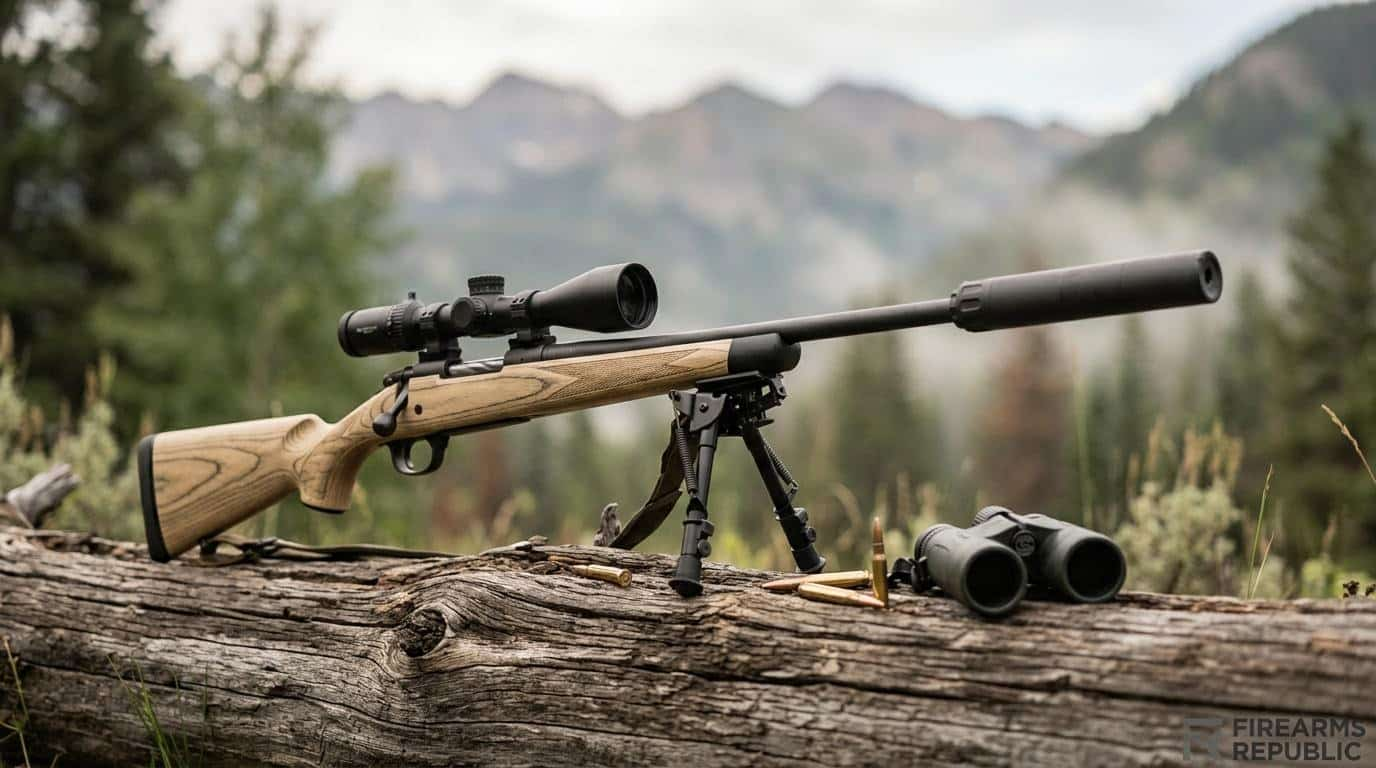
Suppressor adoption among hunters has grown faster in the last five years than in the previous 30 combined, and for good reason. A suppressed hunting setup isn’t about being quiet for its own sake – it’s about protecting your hearing in situations where ear protection isn’t practical, reducing the concussion that spooks game after a first shot, and making follow-up shots more accurate because you can hear and see what’s happening instead of recovering from a 165 dB blast. The technology is mature, the equipment is better and more affordable than it’s ever been, and 42 states now permit suppressor ownership and hunting use. This guide covers the best complete suppressed hunting setups by use case – from deer hunting bolt guns to suppressed hog AR builds to backcountry setups where weight matters – with specific rifle, suppressor, and ammunition recommendations rather than theoretical frameworks.
The Case for Suppressed Hunting: What It Actually Does
Before getting into specific setups, it’s worth being concrete about what a suppressor does and doesn’t do in a hunting context, because marketing language has created unrealistic expectations in both directions.
What a suppressor does:
A centerfire rifle suppressor reduces the report of a supersonic rifle by approximately 25–35 dB. An unsuppressed .308 Winchester generates roughly 165 dB at the shooter’s ear – well above the 140 dB threshold for immediate hearing damage. A quality suppressor on a .308 reduces this to approximately 130–135 dB – still loud, but below the immediate damage threshold and dramatically less concussive. Subsonic loads reduce the suppressed report further: .300 Blackout with 220gr subsonic ammunition through a suppressor produces approximately 125–130 dB, comparable to a suppressed .22 LR.
The game-spook reduction is real but often overstated. A suppressed supersonic rifle still produces a loud crack from the supersonic bullet’s shockwave – this is the sound of the bullet traveling faster than sound, and no suppressor eliminates it. Animals within 200 yards typically still react to the shot. What the suppressor eliminates is the muzzle blast and the disorienting concussion – the directional cue that tells game exactly where the shot came from. In practice, hunters report that suppressed shots spook game less because the sonic crack is harder to locate than the full muzzle report. On a group of hogs, this is the difference between one shot and four shots before they scatter.
Hearing protection is the most underappreciated benefit. Most hunters do not wear hearing protection in the field – it reduces situational awareness and is impractical to put on before a shot opportunity. The accumulated hearing damage from decades of unsuppressed hunting is significant. A suppressor is the only practical hearing protection solution for field hunting conditions.
What a suppressor doesn’t do:
Suppressors don’t make rifles whisper-quiet. Subsonic loads through a pistol suppressor approach that level; centerfire rifle suppressors on supersonic loads do not. If your expectation is movie-quiet operation, you’ll be disappointed. If your expectation is meaningful hearing protection and reduced game disturbance, you’ll be satisfied.
Suppressors add weight (typically 14–24 oz) and length (5–9 inches). In a hunting context, added length matters on lever guns and compact rifles configured for thick cover; it’s largely irrelevant on a standard hunting bolt gun.
The NFA Process: What to Expect
Suppressors are NFA-regulated items requiring a $200 tax stamp and ATF Form 4 approval. The process involves a background check, fingerprints, a passport photo, and a waiting period. Current Form 4 wait times run approximately 6–10 months for individual purchases and 3–6 months for NFA trust purchases. The trust route (creating a simple NFA gun trust) allows multiple designated trustees to possess and use the suppressor legally and is the recommended approach for most buyers.
Purchase steps in brief: select a suppressor, complete the Form 4 at your local dealer, submit fingerprints and photos, pay the $200 tax stamp, and wait for ATF approval. The suppressor stays at the dealer during the wait. Once approved, you take possession and can use it immediately. Our Suppressor Buyer’s Guide covers the full process, trust setup, and state-by-state legality in detail.
States where suppressor hunting is currently prohibited: California, Illinois, New Jersey, New York, Massachusetts, Rhode Island, Hawaii, and Delaware prohibit suppressor ownership entirely. Iowa and Vermont allow ownership but prohibit hunting use. Check your state’s current status before purchasing.
Setup 1: Suppressed Deer Hunting – Bolt Action
The use case: Standard whitetail or mule deer hunting, shots inside 300 yards, bolt-action rifle, hunting from stand or blind. The most common suppressed hunting scenario.
The rifle: Any quality bolt-action with a factory-threaded barrel – the Ruger American Gen II ($650) with its 5/8×24-threaded 22″ barrel is the value choice, the Tikka T3x Lite ($875) is the performance choice. Both come threaded from the factory. If your current hunting rifle isn’t threaded, a gunsmith can thread the barrel for $80–$150 in most cases – often the cheapest path if you already have a rifle you shoot well.
The suppressor: A mid-size .30-caliber suppressor covers .308, 6.5 Creedmoor, .30-06, and most common hunting calibers on a single can. The Dead Air Sandman-S ($900) is the benchmark – it’s compact (6.8″, 17.4 oz), rated for magnum use, and produces 32 dB of reduction on .308. The SilencerCo Omega 300 ($1,000) is slightly longer but produces 34 dB reduction and is one of the quietest .30-cal cans available. The Rugged Radiant ($650) is the budget entry point without significant performance compromise. For hunters who primarily shoot 6.5 CM or smaller calibers, a dedicated 6.5mm suppressor like the Dead Air Ghost-M ($850) is slightly quieter than a .30-cal can on the same host.
The ammunition: Standard supersonic hunting loads work through any suppressor. The suppressor’s job is to reduce the muzzle blast; it doesn’t affect terminal performance. Use the same Hornady Precision Hunter, Federal Trophy Bonded, or Nosler Partition loads you’d use unsuppressed. Zero the rifle with the suppressor attached – most quality suppressors produce a point-of-impact shift of 0.5–2 inches at 100 yards versus unsuppressed fire, and you want to know your zero with the can on.
Total system cost: $1,100–$1,900 (rifle + suppressor + $200 tax stamp + gunsmithing if needed). The wait is 6–10 months; plan accordingly by starting the process before the season you want to hunt suppressed.
Performance expectation: Suppressed .308 supersonic at 130–135 dB. No immediate hearing damage threshold crossed. Game within 200 yards still hears the shot but the report is significantly less directional. First-shot recovery is faster – you can hear the hit and see the deer’s reaction clearly rather than recovering from concussive blast.
Setup 2: Suppressed Hog Hunting – AR-15 Build
The use case: Feral hog hunting at night or in low-light, multiple shots common, shots inside 150 yards typically, requiring quiet operation for back-to-back encounters. This is the use case where suppressor value is highest.
The rifle: A quality AR-15 in .300 Blackout is the purpose-built answer. The Ruger AR-556 MPR in .300 Blackout ($700–$800) and the PSA PA-15 .300 Blackout pistol/carbine ($500–$600) are reliable production options. For hunters who want to configure an existing AR-15 for .300 Blackout, a dedicated .300 Blackout upper assembly ($350–$600) drops onto any standard AR-15 lower – the only additional change needed is .300 Blackout-specific magazines (standard AR-15 magazines work but dedicated .300 BLK mags feed more reliably with subsonic loads).
Barrel length matters significantly in .300 Blackout suppressed configurations. A 16″ barrel is optimal for supersonic loads; a 10.5″–12.5″ barrel is the common choice for suppressed subsonic builds because the shorter barrel keeps overall length manageable with the suppressor attached and subsonic loads don’t benefit from extra barrel length the way supersonic loads do. A 10.5″ .300 Blackout barrel with a 7″ suppressor produces a 24.5″ overall length – compact and handy in tight field situations. See our AR-15 Platform Guide for full .300 Blackout AR configuration details.
The suppressor: A dedicated 7.62mm (.30-cal) suppressor rated for full-auto and sustained fire handles the volume of a hog hunting session better than lighter units. The Dead Air Sandman-S ($900) is again the top pick – its direct-thread and KeyMo mounting options work with most .300 Blackout barrels, it handles full-auto sustained fire, and it’s rated for the 5/8×24 thread pitch standard on most .300 BLK barrels. The SilencerCo Omega 36M ($1,100) is a multi-caliber suppressor (handles .223 through .300 WM) that makes sense for hunters running both AR-15 and bolt-gun platforms who want one suppressor for everything.
The ammunition: This is where the setup gets particularly interesting. .300 Blackout subsonic loads (220gr Hornady Sub-X, Remington Subsonic Hunting, or Barnes 190gr TAC-TX Subsonic) produce approximately 125–130 dB suppressed – the quietest practical centerfire hunting combination. At 100 yards, the 220gr Sub-X hits with approximately 465 ft-lbs of energy – adequate for coyotes and smaller hogs (under 100 lbs) with clean broadside shots. For larger boars, switch to supersonic .300 Blackout (Hornady Black 110gr V-Max at 2,350 fps, 1,347 ft-lbs) or use the suppressed setup on smaller animals and an unsuppressed .308 for the big pigs. The subsonic/supersonic flexibility is unique to .300 Blackout in the AR-15 format and is a major reason for its popularity in suppressed hog hunting. See our .300 Blackout Caliber Guide for complete ballistic data.
Night optics pairing: This setup pairs naturally with a thermal or night vision scope. A rifle-mounted thermal (AGM Rattler TS35-384, $900–$1,100) or digital night vision (Sightmark Wraith HD, $500) attaches to the Picatinny rail and handles low-light and dark conditions. See our Night Hunting Rifles & Optics Guide for complete optics recommendations.
Total system cost: $1,400–$2,000 for rifle + suppressor + tax stamp. Add $500–$1,100 for thermal optic. A complete capable night hog setup runs $2,000–$3,000 all-in.
Performance expectation: Subsonic loads at 125–130 dB suppressed, making multiple shots in the same area practical without scattering the group. A 10-hog encounter at a feeder is genuinely workable with this setup in a way it isn’t with any unsuppressed configuration.
Setup 3: Suppressed Predator Hunting – .223 Bolt or AR-15
The use case: Coyote hunting at call-in distances (30–200 yards), where the primary goal is not spooking other coyotes in the area after a first shot, and where hearing protection in field conditions is impractical.
The rifle: An AR-15 in .223 Remington with an 18″–20″ barrel is the standard choice – Ruger AR-556 ($700), PSA Gen3 PA-15 ($450–$550), or Aero Precision M4E1 complete build ($700–$900) all provide reliable platforms. The 18″–20″ barrel extracts better velocity from .223 than a 16″ barrel (roughly 100 fps more) which improves both range and terminal performance on coyotes. A bolt-action in .223 (Savage Axis II, $450; Ruger American Gen II, $650) works well for hunters who primarily call single animals at known distances and want the simplicity of a bolt gun without the AR platform complexity.
The suppressor: A dedicated 5.56mm suppressor is quieter and lighter than a .30-cal can on a .223 host. The Dead Air Nomad-L ($800) is a full-size 5.56 suppressor producing 34–36 dB reduction on .223 – very quiet for a centerfire rifle. The SilencerCo Omega 36M ($1,100) covers both .223 and .308 for hunters who want one suppressor for predators and deer. The Rugged Razor ($650) is the value entry point. For hunters committed to a 5.56-only host, the dedicated 5.56 cans outperform multi-caliber suppressors in sound reduction.
The ammunition: 55gr Hornady V-Max or Sierra BlitzKing for coyotes inside 200 yards – these varmint bullets fragment rapidly and are extremely accurate in most .223 barrels. For longer shots (200–300 yards), heavier 69gr or 77gr bullets (Sierra MatchKing, Hornady ELD-M) have better BC and drift less in wind. True subsonic .223 (60gr at under 1,100 fps) is available but produces very limited terminal performance – subsonic .223 is not a practical hunting load. The suppressor on supersonic .223 still provides meaningful noise and blast reduction even without the subsonic option.
Total system cost: $1,100–$1,750 for rifle + suppressor + tax stamp. A complete capable predator setup on a mid-range budget.
Setup 4: Suppressed Elk and Large Game – Bolt Action with Magnum
The use case: Western big game hunting – elk, mule deer, large black bear – where shots extend to 300+ yards and hearing protection during the hunt is impractical. The suppressor also reduces spook on second-shot opportunities on elk that don’t immediately go down.
The rifle: Any quality bolt-action in 6.5 Creedmoor, .308 Winchester, 7mm PRC, or .30-06, factory-threaded or gunsmith-threaded. The Bergara B-14 Hunter ($1,000) in 6.5 CM or 7mm PRC is the best all-around platform – Rem 700 footprint for aftermarket flexibility, 0.5 MOA accuracy, and available with threaded muzzle. The Tikka T3x Lite ($875) is the weight-priority choice. The Christensen Mesa ($1,500) in 7mm PRC is the backcountry premium option. For magnum hunters (.300 Win Mag, 7mm Rem Mag), ensure the suppressor is rated for the pressure – the Sandman-S and SilencerCo Omega 300 both handle full magnum loads.
The suppressor: For elk-class game, a full-size .30-cal suppressor optimized for larger calibers. The SilencerCo Omega 300 ($1,000) is the benchmark for versatility and sound reduction – 34 dB on .308, works on 6.5 CM through .300 Win Mag. The Thunderbeast Ultra 7 ($900) is purpose-built for bolt-gun hunting use – lightweight (12.5 oz), minimal POI shift, and extremely consistent baffle alignment. The Dead Air Sandman-L ($1,000) is the heavy-duty option for hunters who will use the same suppressor on semi-auto hosts as well.
Weight consideration for backcountry: A suppressor adds 14–24 oz to a rifle system that backcountry hunters are already trying to keep under 8.5 lbs scoped. The Thunderbeast Ultra 7 at 12.5 oz is the lightest quality .30-cal option. Some backcountry hunters choose not to suppress for exactly this reason – the weight savings of leaving the suppressor home is meaningful over 10-mile days. For hunters doing vehicle-accessible western hunts from a base camp, weight is not a constraint and the hearing protection benefit is straightforward. See our Mountain / Backcountry Hunting Rifles guide for the full western weight calculus.
Total system cost: $1,875–$2,700 (rifle + suppressor + tax stamp). Add optics ($300–$900) for a complete western big game suppressed system of $2,500–$3,600.
Setup 5: Suppressed .22 LR – Small Game and Training
The use case: Small game hunting (squirrel, rabbit), pest control, and training use where extremely quiet operation is practical. A suppressed .22 LR is genuinely whisper-quiet – approximately 110–115 dB with subsonic ammunition, hearing-safe without additional protection.
The rifle: The Ruger 10/22 ($300–$350) with a threaded barrel (Ruger factory threaded models or a $100 aftermarket threaded barrel) is the standard platform. The Savage Mark II ($250–$300) in bolt-action and the CZ 455 ($400–$500) are quality alternatives for hunters who prefer bolt-action. For pest control applications where capacity matters, the 10/22’s 10-round rotary magazine (25-round BX-25 available) is the practical choice.
The suppressor: A dedicated .22 LR suppressor is smaller, lighter, and quieter than using a multi-caliber suppressor on a rimfire. The SilencerCo Sparrow 22 ($400) is the benchmark – reliable, user-serviceable, and very quiet (at 116 dB on .22 LR subsonic). The Dead Air Mask HD ($350) is a competitive alternative with similarly excellent sound reduction. The Rugged Octet 22 ($350) is the budget option with slightly lower performance. Rimfire suppressors require periodic cleaning (the lead and powder residue from rimfire ammunition is heavy) – user-serviceable designs are strongly preferred over non-serviceable units.
The ammunition: CCI Standard Velocity 40gr ($5–$6/50 rounds) and CCI Quiet 710 fps ($6/50 rounds) are the standard suppressed .22 LR choices. The Quiet load at 710 fps is subsonic through any rifle barrel and produces minimal bolt cycling sound in semi-auto actions. For varmint hunting where range extends past 75 yards, CCI Segmented Subsonic 40gr performs better terminally. Standard supersonic .22 LR through a suppressor is not substantially quieter than unsuppressed due to the supersonic crack.
Total system cost: $750–$1,050 (rifle + suppressor + tax stamp). The most affordable complete suppressed hunting system available.
Suppressor Comparison: Best Cans by Use Case
| Suppressor | Price | Weight | Calibers | dB Reduction | Best For |
|---|---|---|---|---|---|
| Dead Air Sandman-S | $900 | 17.4 oz | .30 cal and under | 32 dB (.308) | All-around bolt + AR |
| SilencerCo Omega 300 | $1,000 | 14 oz | .30 cal and under | 34 dB (.308) | Quietest .30 cal option |
| Thunderbeast Ultra 7 | $900 | 12.5 oz | .30 cal and under | 30 dB (.308) | Lightest backcountry option |
| SilencerCo Omega 36M | $1,100 | 16 oz | .223 through .300 WM | 33 dB (.308) | Multi-platform one-can solution |
| Dead Air Nomad-L | $800 | 16.4 oz | 5.56 and under | 34–36 dB (.223) | Dedicated .223/.224 host |
| Rugged Radiant | $650 | 17 oz | .30 cal and under | 30 dB (.308) | Budget .30 cal entry point |
| SilencerCo Sparrow 22 | $400 | 4.2 oz | .22 LR / .17 HMR | 41 dB (.22 LR) | Rimfire small game |
Mounting Systems: Direct Thread vs. Quick Detach
Most suppressors attach to the host rifle via direct thread – the suppressor screws onto the muzzle threads. Direct thread is reliable, simple, and introduces minimal POI shift. The limitation is that attaching and removing requires hand-tightening the suppressor each time, and the suppressor must be fully cooled before removal after extended fire.
Quick detach (QD) mounting systems allow the suppressor to mount and remove without hand-tightening. The Dead Air KeyMo, SilencerCo ASR, and OSS mount systems all use proprietary locking mechanisms that allow mounting in seconds. QD systems are valuable for hunters who frequently switch between suppressed and unsuppressed use on the same host rifle, or for hunters who own one suppressor and want to move it between multiple host rifles quickly. The trade-off is that QD mounts require a compatible muzzle device (flash hider or brake) already installed on the host rifle, and QD mounting systems tend to produce slightly more POI shift than direct thread due to the additional moving parts.
For most hunters who will leave the suppressor mounted throughout the season, direct thread is the simpler and more reliable solution. For hunters who share a suppressor across multiple rifles or frequently hunt both suppressed and unsuppressed, the QD investment is worthwhile.
Ammunition POI Shift: What to Expect
Every suppressor produces some point-of-impact shift versus unsuppressed fire. The physics: the suppressor adds mass ahead of the muzzle that slightly changes barrel harmonics, and the enclosed gas system affects the muzzle’s exit behavior in ways that differ from the open air. In practice, most quality hunting suppressors produce 0.5–2.0 inch POI shift at 100 yards when going from unsuppressed to suppressed fire.
The practical rule: always confirm zero with the suppressor attached before hunting. If you’re hunting without the suppressor and plan to add it mid-season, re-zero. Most hunters who suppress their hunting rifle leave the suppressor permanently attached and zero with it on – this eliminates the variable entirely. Direct-thread suppressors on hunting bolt guns almost always stay on. A suppressor that’s attached at the beginning of deer season stays on until the season ends.
Pros and Cons of Suppressed Hunting
Strengths: ✓ Meaningful hearing protection – below immediate damage threshold with quality can ✓ Reduced muzzle blast reduces first-shot recovery time for accurate follow-up ✓ Less game spook on missed or non-fatal first shots – better second shot opportunities ✓ On subsonic .300 BLK, group of hogs doesn’t scatter after first shot ✓ Reduced muzzle flash – less disorientation in low-light hunting conditions ✓ Better communication with hunting partners immediately after shot ✓ Reduced shot disturbance to neighbors in agricultural settings
Trade-offs to accept: ✗ NFA process – $200 tax stamp, 6–10 month wait, background check and fingerprints ✗ Added weight (12–24 oz) and length (5–9 inches) to the rifle system ✗ POI shift requires re-zeroing with suppressor attached ✗ Supersonic loads still produce sonic crack – not silent, just quieter ✗ Suppressor maintenance required, especially on rimfire cans ✗ State restrictions – not legal in 8 states for ownership, additional states restrict hunting use
Frequently Asked Questions
Q: Is suppressed hunting worth the wait and cost?
A: For most hunters who go through the process, yes – the verdict from the hunting community is overwhelmingly positive once the can is in hand. The hearing protection benefit alone is worth it for hunters who hunt frequently over decades. The game disturbance reduction is a real secondary benefit, especially for hog hunters who rely on multiple shots per encounter. The $200 tax stamp is a one-time cost; quality suppressors last indefinitely with proper maintenance. The 6–10 month wait is the primary barrier – start the process during the off-season so the suppressor is approved before the season you want to hunt with it.
Q: What caliber suppressor do I need for deer hunting?
A: A .30-caliber suppressor (rated for .308 Winchester) covers nearly all deer hunting scenarios – it works on .308, 6.5 Creedmoor, .30-06, 7mm PRC, .300 Win Mag, and most other hunting calibers. The Dead Air Sandman-S and SilencerCo Omega 300 are the two most recommended options. If you exclusively hunt with 6.5 Creedmoor or smaller calibers, a dedicated 6.5mm suppressor is slightly quieter and often lighter. If you want one suppressor for multiple calibers including rifle and pistol, the SilencerCo Omega 36M handles everything from .22 LR to .300 Win Mag on a single unit.
Q: Will a suppressor hurt my rifle’s accuracy?
A: No – quality suppressors improve or maintain accuracy in most cases. The enclosed gas system provides a more consistent muzzle exit condition than open-air unsuppressed fire, and many shooters see slight group size improvements with a suppressor attached. The only accuracy-related concern is POI shift (where the bullet hits changes with and without the suppressor) which requires zeroing with the can attached. Once zeroed suppressed, accuracy is at least as good as unsuppressed and often marginally better.
Q: Can I hunt deer with .300 Blackout subsonic through a suppressor?
A: Technically yes in states where .300 Blackout is legal for deer hunting, but it’s not recommended. Subsonic .300 BLK generates approximately 465 ft-lbs of energy at 100 yards – below the 1,000 ft-lbs commonly cited as the minimum for ethical deer kills. Subsonic .300 BLK is appropriate for coyotes and smaller hogs inside 75 yards with clean broadside shots; it’s marginal for deer and requires perfect shot placement at close range. For deer, use supersonic .300 Blackout (Hornady Black 110gr, 1,347 ft-lbs at the muzzle) or switch to a deer-appropriate cartridge like .308 or 6.5 CM with a .30-cal suppressor.
Q: What’s the one-suppressor solution for a hunter with multiple rifles?
A: The SilencerCo Omega 36M ($1,100) is the best single-suppressor solution for hunters with multiple host rifles. It handles calibers from .22 LR through .300 Winchester Magnum on a single unit, uses the SilencerCo ASR quick-detach mounting system for fast host switching, and produces competitive sound reduction across the caliber range. The trade-off is that it’s heavier than dedicated single-caliber suppressors and more expensive. For hunters who own a .223 AR and a .308 bolt gun and don’t want to buy two NFA items, the Omega 36M is the answer. Quick-detach mounts need to be installed on each host rifle, but a gunsmith can do this for $50–$80 per rifle.
Q: Does a suppressor change where my rifle is zeroed?
A: Yes, typically by 0.5–2 inches at 100 yards. Always zero with the suppressor attached and leave it attached for hunting – this eliminates the variable entirely. If you need to shoot unsuppressed at any point (suppressor at the NFA dealer, lent to a trust member, etc.), re-confirm zero. Rifles with muzzle brakes or flash hiders that are removed when a suppressor is installed sometimes show more dramatic POI shift – in these cases, a suppressor-ready muzzle device (taper mount, ASR compatible) maintains more consistent harmonics.
Related Guides
- Suppressor Buyer’s Guide
- Night Hunting Rifles & Optics Guide
- Hog Hunting Rifle Guide
- .300 Blackout Caliber Guide
- AR-15 Platform Guide
- AR-10 Platform Guide
- Predator / Coyote Hunting Rifles
- Best One-Rifle Solution for Hunting
- Mountain / Backcountry Hunting Rifles
- Ruger American Complete Guide
- Tikka T3x Complete Guide
- Bergara B-14 Series Guide
- Home Defense Rifle Guide
- Small Game Hunting Rifles