 Maksym Kovaliov
The Complete Breakdown – History, Calibers, Builds & Best Rifles
No rifle platform in American history has been adopted by more shooters for more purposes than the AR-15. It’s the most customizable production firearm ever made, the dominant platform in practical competition, the standard home defense rifle of a generation, and – increasingly – a serious hunting tool across calibers from .223 to .450 Bushmaster. As of 2023, there are an estimated 24 million AR-15-pattern rifles in civilian circulation in the United States.
That popularity creates a problem: the sheer volume of information, misinformation, options, and opinions about the AR-15 is overwhelming for anyone new to the platform. This guide cuts through it. You’ll find the history of how the AR-15 became what it is, a clear technical breakdown of how it works, the full caliber landscape (it’s far wider than most people realize), what to look for in a production rifle, and a systematic approach to building or upgrading.
History of the AR-15
The ArmaLite Years: 1957–1959
The AR-15 was designed by Eugene Stoner at ArmaLite as a scaled-down version of his earlier AR-10 battle rifle. Where the AR-10 Platform chambered the 7.62×51 NATO cartridge, Stoner’s new design accepted a smaller, lighter .222 Remington-derived cartridge – eventually standardized as .223 Remington – and used an aluminum receiver and composite stock to reduce weight dramatically compared to contemporary service rifles like the M1 Garand and M14.
The design incorporated Stoner’s direct impingement gas system – propellant gas bled from the barrel traveling directly to the bolt carrier group – and an inline stock that placed the recoil force along the axis of the bore rather than below it, reducing muzzle rise. The result was a rifle that weighed 6.5 lbs loaded and produced modest recoil, compared to the 9.5 lb M14.
ArmaLite demonstrated the AR-15 to military evaluators in 1957 but lacked the manufacturing capacity to fulfill a military contract. The company sold the AR-15 design rights to Colt in 1959.
Colt and Vietnam: 1960–1970
Colt introduced the AR-15 to commercial markets in 1963 and simultaneously pursued military contracts aggressively. The rifle was adopted by the U.S. Air Force in 1962, then by the Army in 1964 under the designation M16. By 1969 it was the standard U.S. infantry weapon in Vietnam.
Early M16s suffered reliability problems in Vietnam – largely the result of a powder change that increased cyclic rate, combined with inadequate cleaning kits and incorrect chrome-lining decisions – but a corrected version, the M16A1, proved reliable and remained the U.S. service rifle until the M16A2 replaced it in 1983. Colt maintained a stranglehold on civilian AR-15 sales through patent protection until the early 1990s. The rifles were popular but expensive and limited to a single manufacturer’s configurations.
The Patent Expiration and Market Explosion: 1990s–2000s
Colt’s AR-15 patents expired in the early 1990s. Within a decade, dozens of manufacturers entered the market – DPMS, Bushmaster, Olympic Arms, Rock River Arms, CMMG, and others – and prices dropped dramatically. The AR-15 became genuinely accessible.
The 1994 Federal Assault Weapons Ban (AWB) restricted certain features on semiautomatic rifles – bayonet lugs, flash hiders, folding stocks, and magazine capacity over 10 rounds – but did not ban the platform outright. When the AWB sunset in 2004, demand exploded. Sales of AR-15-pattern rifles increased year over year through the 2000s as the platform became established as the standard American sporting rifle.
The Modern Era: 2010–Present
The 2010s brought a professionalization of the AR-15 market. Companies like Daniel Defense, BCM (Bravo Company Manufacturing), LaRue Tactical, Noveske, and LMT elevated build quality to military contract standards. The flat-top upper receiver (replacing the earlier carry handle design) became universal, enabling the mounting of modern optics. Free-float handguards replaced the delta ring system. Match-grade triggers, adjustable gas blocks, and premium barrels created a precision ceiling that rivals purpose-built bolt-action rifles in some configurations.
Today the AR-15 is available from over 100 manufacturers at price points from $400 to $4,000+, in more than 20 chamberings, and with an aftermarket ecosystem encompassing thousands of parts from hundreds of suppliers.
How the AR-15 Works
Direct Impingement Gas System
The AR-15’s operating mechanism is direct impingement (DI). When a round fires, propellant gas is bled through a port in the barrel, travels down a gas tube, and enters the bolt carrier key – a fitting welded to the top of the bolt carrier group. The gas expands inside the carrier, driving it rearward against the buffer and recoil spring. As the carrier moves back, the bolt rotates and unlocks from the barrel extension, and the case is extracted and ejected. The buffer and spring drive everything forward again, stripping the next round from the magazine and chambering it.
The elegance of the system is its simplicity and light weight – no piston, no pushrod, no op-rod. The tradeoff is that combustion gases are deposited inside the receiver with every shot, requiring regular cleaning.
Short-Stroke Piston Variants
A minority of AR-15s use a short-stroke piston system (HK 416, LWRC, Adams Arms, Ruger SR-556). Gas drives a piston that drives the bolt carrier – the receiver stays cleaner, the rifle runs cooler, and suppressed shooting produces less gas blowback into the shooter’s face. Piston ARs run reliably with minimal lubrication. They’re also heavier, more expensive, and some designs affect accuracy by adding a moving mass forward of the receiver. For most shooters, the benefits don’t outweigh the cost premium.
Upper and Lower Receiver Architecture
The AR-15 splits at two takedown pins:
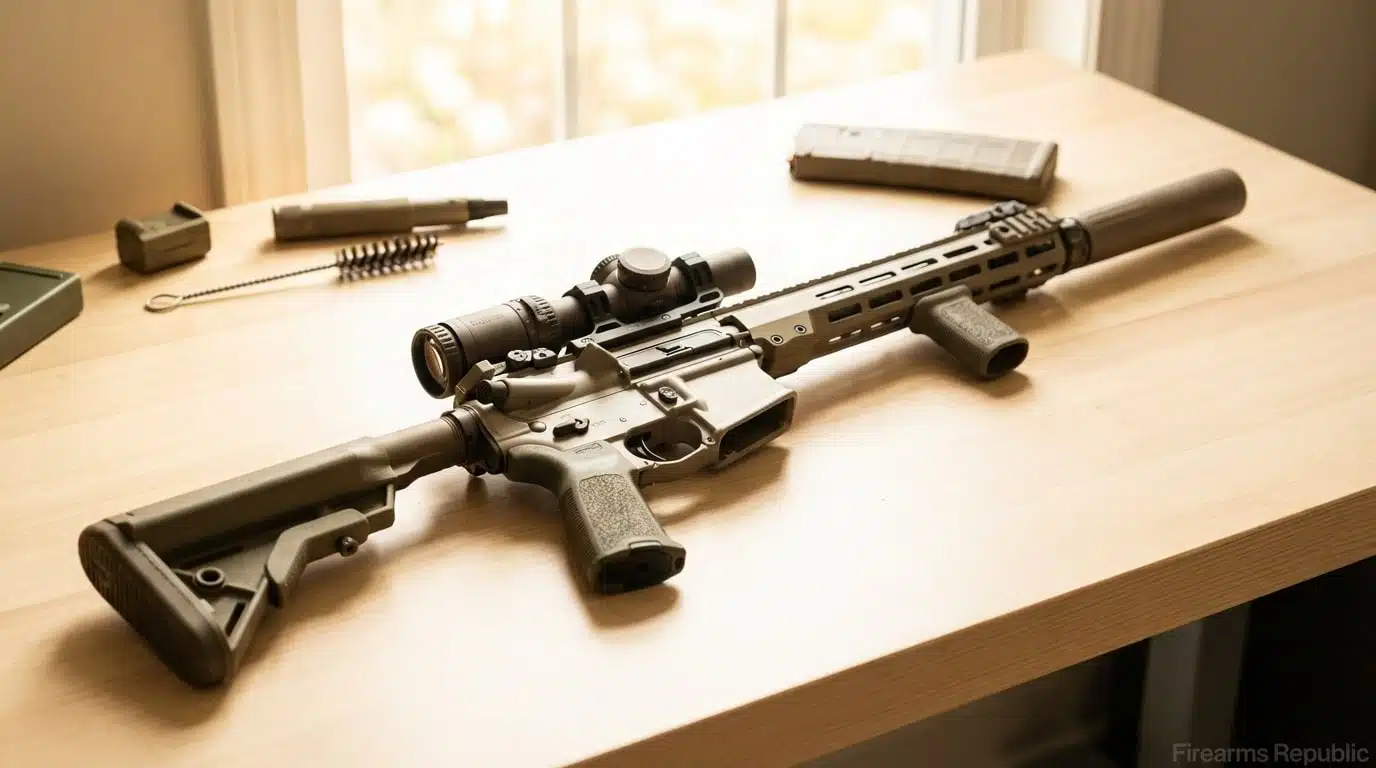
Upper Receiver: Barrel (threaded into upper receiver), gas block and gas tube, handguard / free-float rail, Bolt Carrier Group (BCG), charging handle, forward assist, dust cover, brass deflector.
Lower Receiver: Trigger group (fire control group), buffer tube / buffer / recoil spring, pistol grip, stock or brace, magazine well and magazine release, bolt catch, safety selector, takedown pins.
The upper and lower are joined by two pins with no torque specification – the “slop” between them is by design, allowing field assembly and disassembly without tools. This modularity is what makes the AR-15 the most customizable production firearm available: any mil-spec upper drops onto any mil-spec lower, enabling caliber changes, barrel length changes, and configuration changes without replacing the entire rifle.
Gas System Lengths
Gas system length – the distance from the chamber to the gas port – is one of the most misunderstood variables in AR-15 performance.
| Gas Length | Typical Barrel Length | Dwell Time Characteristics |
|---|---|---|
| Pistol | 7″–10.5″ | Fast, harsh cycle; needs heavier buffer |
| Carbine | 10″–16″ | Standard for most factory rifles |
| Mid-length | 14″–18″ | Softer recoil impulse, more reliable extraction |
| Rifle-length | 18″–24″ | Smoothest cycling, lowest felt recoil |
For most applications, mid-length gas on a 16″ barrel is the sweet spot – softer recoil than carbine-length, reliable extraction, and manageable dwell time with suppressor use.
Mil-Spec vs. Commercial: What It Actually Means
“Mil-spec” is the most overused and misused term in AR-15 marketing. Here’s what it actually specifies:
Buffer Tube Diameter Mil-spec: 1.148″ outer diameter, angled end. Commercial: 1.168″ outer diameter, slanted end. These are not interchangeable. A mil-spec stock on a commercial buffer tube won’t fit correctly, and vice versa. Most quality manufacturers use mil-spec. If you’re buying a replacement stock, match the tube diameter.
BCG (Bolt Carrier Group) Standards True mil-spec BCG requirements include: Bolt in Carpenter 158 steel (C158), shot-peened, magnetic particle inspected (MPI). Carrier in 8620 steel, properly staked gas key. Bolt face hard chrome lined or properly coated. Many budget BCGs use inferior steel or skip the MPI and shot-peening steps. For a range gun, this may not matter. For a defensive rifle or high-round-count training rifle, mil-spec BCG quality is worth the price premium. See our Best AR-15 BCG Guide for specific recommendations.
Barrel Standards Chrome-lined bore and chamber extends barrel life significantly (20,000+ rounds vs. 8,000–10,000 for bare steel), improves corrosion resistance, and is easier to clean – standard on mil-spec barrels. Cold hammer forging (CHF) produces a denser, stronger barrel with longer service life; used on BCM, Daniel Defense, and Colt LE barrels. Button rifling is more common on commercial barrels – accurate, but shorter service life than CHF in high-volume use.
Calibers for the AR-15 Platform
This is where the AR-15 becomes more versatile than most shooters realize. The standard lower receiver accepts uppers in dozens of calibers – some requiring only an upper swap, others requiring a different bolt or magazine as well. See our AR-15 Caliber Selection Guide for a full breakdown of every chambering.
Standard Bore – Drop-In Upper Swap (Same BCG, Same Magazines)
| Caliber | Velocity (16″ bbl) | Energy | Best Use |
|---|---|---|---|
| 5.56 NATO | 3,050 fps (55gr) | 1,134 ft-lbs | General purpose, training, home defense |
| .223 Remington | 3,050 fps (55gr) | 1,134 ft-lbs | Varmints, training (lower pressure than 5.56) |
| .223 Wylde | 3,050 fps (55gr) | 1,134 ft-lbs | Accuracy-optimized chamber for both 5.56 and .223 |
| .22 LR (conversion) | 1,100 fps (40gr) | 107 ft-lbs | Training, cheap practice |
Calibers Requiring Different Bolt Only (Same Lower, Same Magazines)
| Caliber | Velocity (16″ bbl) | Energy | Best Use |
|---|---|---|---|
| .224 Valkyrie | 2,700 fps (90gr) | 1,458 ft-lbs | Long-range varmints, PRS-lite |
| 6mm ARC | 2,750 fps (108gr) | 1,815 ft-lbs | Long range, hunting, growing competition use |
| 6.5 Grendel | 2,580 fps (123gr) | 1,820 ft-lbs | Deer hunting, 800-yard capable |
Calibers Requiring Different Bolt AND Different Magazines
| Caliber | Velocity (16″ bbl) | Energy | Best Use |
|---|---|---|---|
| .300 Blackout | 2,200 fps (110gr supersonic) | 1,181 ft-lbs | Home defense, suppressed, hogs |
| .350 Legend | 2,300 fps (145gr) | 1,705 ft-lbs | Straight-wall deer hunting (Midwest states) |
| .450 Bushmaster | 2,200 fps (250gr) | 2,686 ft-lbs | Large game, straight-wall states |
| .458 SOCOM | 1,900 fps (300gr) | 2,405 ft-lbs | Heavy hogs, subsonic for suppressor |
| .50 Beowulf | 1,900 fps (335gr) | 2,683 ft-lbs | Maximum short-range energy, hogs |
| 9mm (Glock mag) | 1,200 fps (147gr) | 470 ft-lbs | Training, PCC competition |
Caliber Decision Guide
For home defense / general purpose: 5.56 NATO or .223 Wylde. Ammunition is everywhere, affordable for training, and terminal performance with quality defensive loads (77gr OTM, Hornady 75gr TAP) is proven. See our Home Defense Rifle Guide for the full defensive rifle breakdown.
For suppressed use: .300 Blackout is purpose-built for it. Supersonic loads give you hunting capability; subsonic 220gr loads are hearing-safe without a suppressor and whisper-quiet with one – all from the same upper. See our .300 Blackout Caliber Guide for complete suppressed ballistics, and our Suppressor Buyer’s Guide for the NFA process.
For long-range precision: 6mm ARC or 6.5 Grendel. Both use high-BC bullets that stay supersonic past 1,000 yards from a 24″ barrel. 6mm ARC has better factory ammunition support; 6.5 Grendel has been around longer with a deeper barrel and component market. See our 6mm ARC Caliber Guide and 6.5 Grendel Caliber Guide for full ballistic comparisons.
For Midwest / straight-wall deer hunting: .350 Legend (mild recoil, good deer performance) or .450 Bushmaster (more energy for larger deer, heavier recoil). See our Straight-Wall AR Calibers Guide for state-specific guidance and our Best Deer Hunting AR-15 Calibers guide for a full comparison.
For hog hunting with high round counts: 5.56 NATO or .300 BLK. Affordable, semi-automatic fire for multiple fast targets. See our Hog Hunting Rifle Guide for full hog setup recommendations.
Barrel Length Guide
Barrel length affects velocity, overall rifle length, maneuverability, and legal classification (NFA SBR status below 16″).
| Barrel Length | Legal Classification | Velocity Loss vs. 20″ | Best Application |
|---|---|---|---|
| 7″–10.5″ | Pistol / SBR (NFA) | –300 to –500 fps | CQB, suppressed host, range toy |
| 11.5″ | Pistol / SBR (NFA) | –250 fps | Compact suppressed, home defense |
| 14.5″ (pinned muzzle device = 16″) | Rifle (legal) | –150 fps | Mil-spec clone, compact patrol |
| 16″ | Rifle | –100 fps | Most popular length – best balance |
| 18″ | Rifle | –50 fps | Precision, varmint, hunting |
| 20″ | Rifle | Baseline | Maximum velocity, SPR builds |
| 24″ | Rifle | +100 fps | Maximum precision, dedicated bench/competition |
The 16″ barrel is the right call for most shooters. It’s legal without NFA paperwork, handles well in any environment, and gives up only modest velocity compared to longer configurations. The 18″ barrel makes sense if you’re building a dedicated precision or hunting upper and want the extra velocity without NFA complexity.
Handguard and Rail Systems
The handguard is the most visually distinctive component of a modern AR-15 and one of the most practically important – it determines how you hold the rifle, what accessories you can mount, and how much heat your support hand absorbs during sustained fire.
Delta Ring / Drop-In (Legacy)
The original AR-15 handguard design – two plastic halves held by a spring-loaded delta ring on the barrel nut. Simple, light, inexpensive. Still on most budget rifles and mil-spec clones. Limitation: contacts the barrel, which affects harmonics and accuracy.
Free-Float Handguard (Current Standard)
The handguard attaches to a barrel nut or proprietary receiver extension – not the barrel itself. The barrel floats free inside the handguard with nothing touching it forward of the chamber. Benefits: improved accuracy (no barrel contact), better heat management, stronger mounting platform for accessories.
| Mounting System | Description | Best For |
|---|---|---|
| M-LOK | Negative space slots, lightweight | Hunting, general purpose, lightweight builds |
| KeyMod | Earlier negative space system, less popular now | Older builds, niche use |
| Picatinny (1913 rail) | Raised rail standard, heavy | Accessories requiring maximum retention |
| ARCA Rail | Integrated bipod/ballhead mount | Precision / PRS competition |
For most modern builds, M-LOK is the right choice – lighter than full Picatinny, widely compatible with accessories, and the current industry standard. See our Best AR-15 Handguards guide for specific handguard recommendations by use case.
Triggers: The Most Important Upgrade
Factory AR-15 triggers typically break at 6–8 lbs with significant take-up and reset travel. A quality aftermarket trigger transforms how the rifle shoots.
| Trigger | Pull Weight | Best For | Price |
|---|---|---|---|
| LaRue MBT-2S | 4.5 lbs | Best value general purpose | $95 |
| Geissele SSA-E | 3.5 lbs | Two-stage, competition/precision | $265 |
| TriggerTech Adaptable | 1.5–4 lbs | Adjustable, hunting/competition | $235 |
| CMC 3.5 lb single stage | 3.5 lbs | Lightweight single stage | $170 |
| Timney Calvin Elite | 1.5–4 lbs | Top-tier precision | $320 |
| Elftmann SE | 2.5–4 lbs | Competition, ultra-short reset | $260 |
Recommendation: The LaRue MBT-2S at $95 is the best value in AR triggers – a two-stage design with a 4.5 lb break, minimal overtravel, and consistent reset. It upgrades any AR-15 to competition-acceptable performance. The Geissele SSA-E is the step up for serious precision or competition use. See our Best Triggers for AR-15 / AR-10 guide for a full trigger comparison.
Best AR-15 Rifles: Production Models
Premium Tier ($1,800+)
BCM RECCE-16 MCMR is Bravo Company’s flagship production rifle. Every component meets or exceeds mil-spec: cold hammer forged chrome-lined barrel, properly staked BCG gas key, shot-peened bolt. The RECCE-16 in 5.56 NATO with a 16″ mid-length barrel is the go-to recommendation for a serious duty/defensive rifle that will run 50,000 rounds without major component failure. BCM doesn’t cut corners – it just costs accordingly at $1,500–$1,800.
Daniel Defense DDM4 V7 is the premium production AR-15 with the most real-world validation – widely adopted by law enforcement and military units globally. The 16″ cold hammer forged barrel, proprietary DDM4 rail, and tight upper/lower fit produce consistent 1 MOA accuracy from a duty-ready platform. At $1,900–$2,100, it’s expensive, but it’s the rifle you buy when you want a production AR that you never have to second-guess. Available in 5.56 NATO and .300 Blackout.
Noveske N4 Gen 4 builds among the most accurate production ARs available. The Gen 4 features a stainless steel match barrel, adjustable gas block, and a receiver set machined to tolerances tighter than mil-spec. Groups run 0.75 MOA with quality match ammunition. At $2,200+, it occupies a niche between duty rifle and precision tool – appropriate for competition shooters who don’t want to build from scratch.
LMT (Lewis Machine & Tool) MARS-L features a monolithic rail system lower machined from a single piece of aluminum – eliminating the buffer tube wobble present in every standard design. Combined with LMT’s chrome-lined hammer-forged barrel, the MARS-L is among the most mechanically reliable AR-15s available. At $2,500+, it’s a serious investment.
Mid-Range ($800–$1,800)
Aero Precision M4E1 Complete Rifle is the best value for a quality complete rifle. Aero’s upper/lower fit is noticeably tighter than most manufacturers at this price point, and their Enhanced upper receiver improves the handguard mounting interface. Complete 16″ rifle runs $850–$1,000. Aero is also the dominant choice for custom builds – their stripped receivers and uppers have best-in-class machining quality at accessible prices.
Ruger AR-556 delivers a reliable, mil-spec carbine at $750–$900. The AR-556 isn’t flashy – standard carbine handguard, standard trigger, standard everything – but every component is within mil-spec tolerances and Ruger’s quality control is consistent. It’s the right choice if you want a functional AR-15 from a reputable manufacturer without paying a premium for features you don’t need.
Smith & Wesson M&P15 Sport II is S&W’s volume seller at $700–$800. It delivers a Melonite-finished barrel (corrosion-resistant, nearly as durable as chrome-lining), a functional trigger, and reliable operation. A solid entry-level AR from a name-brand manufacturer.
Springfield Armory SAINT Victor improves on the basic AR-15 formula in meaningful ways: nickel boron-coated BCG (easier cleaning), 1:8 twist barrel (handles heavier 62–77gr bullets well), and M-LOK free-float handguard as standard. At $900–$1,000, it’s a better-equipped out-of-box AR than similarly priced competitors. Good choice if you want an AR that’s genuinely ready for precision loads without immediate upgrades.
Wilson Combat Protector Carbine features a Lothar Walther match barrel, quality BCG, and Wilson’s trigger job. Accuracy runs sub-MOA with match loads. At $1,600, it occupies a niche between duty rifle and precision tool for shooters who want production quality approaching custom.
Budget Tier ($400–$800)
Palmetto State Armory PA-15 sells complete AR-15s from $400–$600. Quality control is inconsistent – some rifles arrive perfectly, others need work out of the box. The trigger is rough, the BCG is basic, and finish quality varies. But PSA rifles are DPMS/mil-spec pattern and fully compatible with aftermarket components. Buy one as a base for systematic upgrades, not as a finished product.
Anderson Manufacturing AM-15 manufactures more AR-15 receivers than any company in the U.S. and sells complete rifles at the lowest price point in the market. At $400–$500, an AM-15 is a functional, legal AR-15. Expect a heavy mil-spec trigger, basic handguard, and standard carbine configuration. Like the PA-15, it’s better viewed as an upgrade platform than a finished rifle.
Del-Ton Echo 316 occupies the budget tier above PSA and Anderson – marginally better quality control, chrome-lined barrel on some configurations, reliable function. At $550–$700, it’s a reasonable choice for a first AR-15 buyer who wants basic functionality without PSA’s quality control lottery.
Model Comparison
| Model | Price | Weight | Barrel | Twist | Accuracy | Best For |
|---|---|---|---|---|---|---|
| BCM RECCE-16 MCMR | $1,700 | 6.9 lbs | 16″ CHF | 1:7 | 1 MOA | Duty, defensive |
| Daniel Defense DDM4 V7 | $2,000 | 6.8 lbs | 16″ CHF | 1:7 | 1 MOA | Duty, all-around |
| Noveske N4 Gen 4 | $2,300 | 6.7 lbs | 16″ SS | 1:8 | 0.75 MOA | Precision, competition |
| LMT MARS-L | $2,600 | 7.1 lbs | 16″ CHF | 1:7 | 1 MOA | Maximum reliability |
| Aero M4E1 | $950 | 6.5 lbs | 16″ | 1:8 | 1.5 MOA | Builds, value |
| Ruger AR-556 | $800 | 6.5 lbs | 16″ | 1:8 | 1.5 MOA | Reliable budget |
| S&W M&P15 Sport II | $750 | 6.5 lbs | 16″ Melonite | 1:8 | 1.5 MOA | Entry level |
| Springfield SAINT Victor | $950 | 6.9 lbs | 16″ | 1:8 | 1.25 MOA | Ready out of box |
| PSA PA-15 | $500 | 6.5 lbs | 16″ | 1:7/1:8 | 2 MOA | Budget / upgrade base |
AR-15 for Competition
The AR-15 is the dominant platform across multiple competitive shooting disciplines.
3-Gun / Multigun
The highest-volume competition application for AR-15s. Stages require rapid engagement of steel, paper, and moving targets at 5–300 yards. Standard configuration: 16″ barrel, 1–6x or 1–8x LPVO optic, 30-round magazines, comp/brake for muzzle control. See our 3-Gun / Multigun Competition Guide for setup details.
PRS Tactical / Gas Gun
Growing segment for precision semi-auto shooting. 5.56 NATO is legal in most PRS tactical divisions; 6mm ARC and 6.5 Grendel uppers offer better long-range ballistics. Setup: 18–20″ barrel, 4–16x scope, bipod, adjustable stock. See our PRS Gas Gun Competition Guide for the full competition picture.
NRL Hunter
The AR-15 in 6.5 Grendel or 6mm ARC competes effectively in hunting-class divisions with shots to 500 yards. Light and maneuverable compared to AR-10 Gas Gun setups.
USPSA Carbine / PCC
9mm AR-15 lower-compatible PCCs dominate USPSA Carbine division. Fast, low-recoil, and the platform’s semi-auto action is built for the movement and engagement speed required by USPSA stages. See our USPSA / PCC Competition Guide for platform and setup guidance.
AR-15 for Hunting
Varmints and Predators (Coyotes, Prairie Dogs)
The AR-15’s natural hunting application. 5.56 NATO, .223 Remington, and .224 Valkyrie deliver flat trajectories and explosive terminal performance on small animals. Semi-automatic fire is practical for prairie dog towns. No legal issues in most states. See our Varmint Hunting Rifles Guide and Predator / Coyote Hunting Rifles guides for application-specific setup.
Deer Hunting
Growing use case, particularly in states that have eliminated the “straight-wall only” restrictions. 6.5 Grendel and 6mm ARC are genuinely effective deer cartridges to 400 yards with appropriate 120–130gr bonded bullets. .350 Legend and .450 Bushmaster dominate Midwest straight-wall states. Check state regulations – some still prohibit semi-automatic centerfire rifles for deer. See our Best Deer Hunting AR-15 Calibers guide for state-by-state caliber guidance.
Hogs
The AR-15’s strongest hunting application. Feral hog hunting involves fast shots at multiple animals – exactly what a semi-automatic platform delivers. .300 Blackout suppressed is ideal for night hunts where noise matters; 5.56 with 62gr bonded bullets handles hog-weight targets reliably. See our Hog Hunting Rifle Guide and Night Hunting Rifles & Optics Guide for complete hog and night hunting setups.
Elk and Large Game
Borderline with standard AR-15 calibers. 6.5 Grendel and 6mm ARC are marginal on elk at ranges past 300 yards – energy drops below recommended minimums. The .450 Bushmaster and .458 SOCOM in an AR-15 deliver adequate energy but are short-range propositions (under 200 yards). For elk hunting with semi-auto, the AR-10 platform in 6.5 Creedmoor is the proper tool. See our AR-15 vs AR-10 guide for the full platform comparison.
Barrel Twist Rate and Bullet Weight
Twist rate is the rate at which the rifling rotates the bullet – expressed as one complete rotation per X inches. Faster twist stabilizes heavier, longer bullets; slower twist is appropriate for lighter bullets.
| Twist Rate | Optimal Bullet Weight | Common Application |
|---|---|---|
| 1:7 | 62–77gr | Mil-spec, heavy defensive loads, tracers |
| 1:8 | 55–77gr | Best all-around – stabilizes full range |
| 1:9 | 45–62gr | Lighter varmint loads |
| 1:12 | 40–55gr | Older commercial rifles, light varmint only |
1:8 twist is the correct choice for most AR-15 builds. It stabilizes everything from 55gr training ammo to 77gr match loads, giving you flexibility across ammunition types. 1:7 is the mil-spec standard and handles heavier bullets marginally better; 1:9 limits you to lighter loads.
Upgrades: Priority Order
- Trigger – The single most impactful upgrade on any AR-15. LaRue MBT-2S ($95) is the starting point; Geissele SSA-E ($265) is the step up for precision or competition. See our Best Triggers for AR-15 / AR-10 guide.
- Optic – The right optic for the job matters more than any other component. A 1–6x LPVO covers 0–300 yards for defensive/competition use; a 4–14x covers hunting and precision; iron sights remain the lowest-weight option for general use. See our Best LPVO Scopes for AR-15 and Best Red Dot Sights for AR-15 guides.
- Free-float handguard – If your rifle has a delta ring handguard, replacing it with a free-float significantly improves accuracy potential and gives you a better grip platform. Budget $80–$200. See our Best AR-15 Handguards guide.
- BCG – If your rifle came with a basic BCG, a mil-spec Carpenter 158 BCG (BCM, Toolcraft, Daniel Defense) runs more reliably and lasts longer. See our Best AR-15 BCG Guide.
- Adjustable gas block – Required for suppressor use or precision work where you want to tune dwell time.
- Charging handle – Radian Raptor ($65), BCM Gunfighter ($40), or Geissele ACH ($90) all improve on the standard mil-spec handle significantly in terms of ambidextrous manipulation and gas deflection with suppressor use.
For a full upgrade roadmap see our Best AR-15 Upgrades Under $200 guide.
Legal Considerations by State
The AR-15’s legal status varies significantly across the United States. Understanding your state’s laws before purchasing is essential.
| State | Status | Key Restrictions |
|---|---|---|
| California | AWB in effect | Featureless or fixed-magazine configuration required |
| New York | AWB in effect | Featureless configuration, 10-round magazine limit |
| New Jersey | AWB in effect | Featureless, 10-round limit |
| Massachusetts | AWB in effect | Pre-ban only or featureless |
| Connecticut | AWB in effect | Registered assault weapons or featureless |
| Maryland | AWB in effect | Featureless, must use Regulated Firearms process |
| Hawaii | AWB in effect | Registration required |
| Illinois | Varies by city | Chicago and Cook County have specific restrictions |
| Washington state | AWB enacted 2023 | Semi-auto rifle purchase age 21+, some feature restrictions |
| All other states | Generally legal | Standard retail purchase with standard 4473 |
Note: Laws change frequently. Always verify current regulations with your state’s attorney general website or a licensed firearms attorney before purchasing.
Maintenance and Reliability
Cleaning Schedule
| Use | Interval |
|---|---|
| Defensive carry / home defense | Every 500 rounds minimum; inspect monthly |
| Training (100–200 rds/session) | Every 500–1,000 rounds |
| Competition (high volume) | Every 300–500 rounds |
| Suppressed shooting | Every 200 rounds (significantly more fouling) |
| Storage / minimal use | Inspect and lightly oil every 6 months |
Lubrication
AR-15s run wet. Unlike bolt-action rifles, AR-15s operate more reliably with generous lubrication – particularly on the BCG cam pin area, bolt lugs, and the inside of the upper receiver where the carrier rides. “Lube until it drips” is an exaggeration, but under-lubrication causes more AR-15 failures than over-lubrication. Key lubrication points: BCG (all surfaces), charging handle, buffer and spring (light coat).
Common Malfunctions and Causes
| Malfunction | Common Cause |
|---|---|
| Failure to feed | Worn/damaged magazine, under-lubrication |
| Failure to extract | Carbon buildup in chamber, extractor spring wear |
| Failure to eject (stovepipe) | Under-gassed, weak extractor spring |
| Bolt over base | Magazine issue, out-of-spec ammunition |
| Double feed | Bad magazine, extractor failure |
The majority of AR-15 malfunctions trace back to three sources: magazines, lubrication, and ammunition. A quality mil-spec BCG and a clean, lubricated rifle with USGI or Magpul magazines will run essentially indefinitely on quality factory ammunition.
Pros and Cons
Strengths:
✓ Ergonomics and controls – Ambidextrous controls available, inline stock reduces perceived recoil, controls are standardized and widely taught
✓ Modularity – Upper swaps change caliber in seconds; the same lower works for a home defense carbine and a precision 6mm ARC varmint rifle
✓ Aftermarket depth – More component options than any other firearm platform in the world
✓ Accuracy potential – Best builds achieve sub-0.5 MOA; even factory rifles at $1,500+ routinely hit 1 MOA ✓ Semi-automatic rate of fire – Practical for competition, hog hunting, defensive use
✓ Platform standardization – Training, accessories, and muscle memory transfer between any mil-spec AR-15 regardless of manufacturer
✓ Suppressor-friendly – Adjustable gas block + quality can = one of the best suppressed experiences available
Limitations:
✗ DI maintenance demands – Carbon in the receiver requires regular cleaning; runs dry unreliably
✗ Legal restrictions – AWB states require featureless or fixed-magazine configurations; this adds complexity and cost
✗ Weight with accessories – A fully kitted AR-15 (optic, light, foregrip, sling) can reach 9–10 lbs – not light
✗ Not for every hunting application – Marginal on elk; illegal for some big game in some states
✗ Learning curve – Clearing malfunctions, bolt manipulation, and maintenance require training that bolt-action rifles do not
✗ Perception issues – The AR-15’s appearance creates social friction in some contexts
Frequently Asked Questions
Q: What is the difference between 5.56 NATO and .223 Remington? Can I shoot both in my AR-15?
A: The two cartridges are nearly identical dimensionally but differ in chamber pressure specifications – 5.56 NATO runs at higher pressure than .223 Remington. A rifle with a 5.56 NATO chamber can safely fire both 5.56 and .223 ammunition. A rifle chambered in .223 Remington should only fire .223 – firing 5.56 in a .223 chamber risks overpressure. The best solution for an AR-15 that will shoot both is a .223 Wylde chamber – it accommodates both cartridges at their full pressure specifications while optimizing the throat geometry for accuracy. Most quality AR-15 barrels today use .223 Wylde.
Q: Do I need a tax stamp (NFA paperwork) for an AR-15?
A: For a standard rifle configuration with a barrel 16″ or longer and an overall length of 26″ or more – no. Standard AR-15 purchases require only a standard Form 4473 background check through an FFL dealer, the same as any rifle purchase. You need an NFA tax stamp ($200, 8–12 month wait) if you want a Short Barreled Rifle (SBR) with a barrel under 16″ or OAL under 26″. You also need a separate $200 stamp for a suppressor. Building an AR-15 pistol (with a pistol brace rather than a stock) avoids SBR classification – but ATF regulations on pistol braces have been subject to ongoing rule changes; verify current status before building. See our Suppressor Buyer’s Guide for the full NFA process.
Q: What’s the best AR-15 for a first-time buyer?
A: For most first-time buyers, the Smith & Wesson M&P15 Sport II ($750) or Ruger AR-556 ($800) are the right answers. Both are from reputable manufacturers with consistent quality control, both are mil-spec compatible for future upgrades, both come with chrome-lined or Melonite barrels, and both are priced low enough that you have budget remaining for an optic and ammunition – which matter more than the rifle brand at this stage. Avoid no-name budget rifles under $500; the savings aren’t worth the quality control risk on a defensive firearm. See our Complete Beginner’s Guide to Buying Your First Rifle for broader first-rifle guidance.
Q: What AR-15 caliber is best for home defense?
A: 5.56 NATO with quality defensive ammunition is the standard recommendation. The most common home defense loads – Hornady 75gr TAP, Federal 55gr Trophy Bonded JSP, Speer Gold Dot 64gr – are designed to expand and fragment reliably in soft tissue while not over-penetrating through typical residential walls compared to common misconceptions. Modern 5.56 hollow point loads actually penetrate fewer walls than most 9mm pistol rounds in testing. If sound suppression matters and you’re willing to pay for a suppressor, .300 Blackout with subsonic loads is the quietest home defense option on the platform – though supersonic 5.56 remains the better terminal performer. See our Home Defense Rifle Guide for a full defensive setup breakdown.
Q: Can I legally build my own AR-15?
A: In most states, yes – building a firearm for personal use (not for sale) is legal under federal law for individuals who are legally permitted to own firearms. The lower receiver is the serialized component (the “firearm” in ATF’s definition); you can purchase a stripped lower through an FFL, then assemble the rest with over-the-counter parts. 80% lower receivers (requiring the builder to complete machining) have been subject to regulatory changes – verify current ATF rules before purchasing one. Several states (California, New York, New Jersey, Connecticut, Hawaii, Maryland, Washington, and others) have specific laws restricting home builds or requiring serialization. Check your state laws before proceeding. See our Best AR-15 Builds guide for complete component lists and build walkthroughs.
Q: How many rounds will an AR-15 barrel last?
A: Barrel life varies significantly by material and use. A chrome-lined, cold hammer forged barrel (BCM, Daniel Defense, Colt LE) is rated for 20,000–30,000 rounds before accuracy degrades noticeably. A Melonite/nitride treated barrel (S&W, many mid-range makers) runs 10,000–20,000 rounds. A bare steel button-rifled barrel may start to open up groups at 8,000–10,000 rounds with full-power 5.56 loads. For most civilian shooters who put 500–1,000 rounds per year through their rifle, barrel life is not a practical concern – your rifle will outlast the barrel regardless of what you buy. High-volume competitors and trainers should factor barrel life into total cost of ownership.
Q: Is an AR-15 good for hunting deer?
A: Yes – with the right caliber and ammunition. Standard 5.56 NATO (.223) is legal for deer in many states but marginal at distances past 150 yards; it’s better suited for smaller animals. For deer hunting, consider: 6.5 Grendel (excellent deer cartridge to 400 yards, runs in standard AR-15 lower with a different bolt and barrel), 6mm ARC (similar capability, better factory ammo support), .350 Legend (straight-wall states, moderate recoil, good deer performance to 200 yards), or .450 Bushmaster (heavier recoil, maximum energy for large-bodied deer). Always use bonded or controlled-expansion bullets for hunting – varmint-style hollow points are not appropriate for deer-sized game. See our Best Deer Hunting AR-15 Calibers guide for the full breakdown.